If you are pricing out tree removal in Virginia this year, the short version is this: most homeowners pay somewhere between $200 and $1,500 to take down a single tree, and the final number comes down to four things, size, access, condition, and what is sitting underneath it. Small ornamental trees sit at the low end. A tall hardwood leaning over your roof sits at the high end.
| Tree size | Typical height | Estimated cost of tree removal |
|---|---|---|
| Small | Up to 30 ft | $150 – $500 |
| Medium | 30 – 60 ft | $400 – $900 |
| Large | 60 – 80 ft | $800 – $1,500 |
| Very large or hazardous | 80 ft+ | $1,500 – $3,000+ |
Those are estimates, not quotes. Two trees that look identical from the street can carry very different price tags once an arborist walks the property. Below is exactly what drives the price of tree removal in the Shenandoah Valley, what tends to get left off cheap estimates, and how to get a number you can actually trust.
The short answer: what most Virginia homeowners pay
For a routine removal, a healthy tree in an open yard with good truck access, you are usually looking at the lower and middle bands above. Sylvan Scapes has published local ranges that put many everyday removals in Staunton and Augusta County between roughly $169 and $700, with stump grinding and bigger jobs priced separately.
The number climbs when the work gets harder or more dangerous. A 70-foot oak hanging over a house, a fence line, and a power line is a different job than the same oak standing alone in a back pasture. You are not paying for the tree. You are paying for the difficulty and the risk of getting it down without damaging anything.
It also helps to know that the headline price almost never tells the whole story. A quote that sounds low can leave the stump in the ground, drop the wood in a pile for you to deal with, or skip the cleanup. A fair quote spells out what is included. The sections below give you the questions to ask so you can compare two estimates that look similar on the surface but cover very different work.
The 4 factors that move your tree removal price
Almost every estimate you receive comes down to these four levers. Understand them and the quote stops feeling like a mystery.
1. Size. Height and trunk diameter drive everything else. A taller tree means more time, more cuts, and more material to haul out. Trunk thickness matters as much as height, since a short fat trunk can hold more wood than a tall skinny one.
2. Access. Can a truck and chipper get within reach of the tree, or does every limb have to be carried by hand across a yard? Tight back lots in older Staunton and Waynesboro neighborhoods often cost more than a wide-open property in rural Augusta County, even for the same size tree, because the crew works slower and hauls farther.
3. Condition. A dead, hollow, or storm-damaged tree is unpredictable. Rotten wood does not behave the way solid wood does when a climber is in it, so the crew has to rig and lower sections instead of dropping them. That care costs more, and it is the part you want done right.
4. What is underneath it. Trees over houses, garages, sheds, decks, fences, septic fields, and power lines all force a slower, rigged removal. The closer the target and the more there is to protect, the higher the price.
Tree removal cost by size, small to very large
Here is how those four factors usually shake out across tree sizes for properties around Staunton, Augusta County, and the wider Valley.
Small trees (up to 30 feet): dogwoods, redbuds, young maples, and similar ornamentals. Often a one-visit job for a small crew. Expect the low end of the range, roughly $150 to $500, more if access is poor.
Medium trees (30 to 60 feet): mature ornamentals and mid-size hardwoods. These usually need a climber or a bucket and a chipper on site. Plan for $400 to $900 in most cases.
Large trees (60 to 80 feet): full-grown oaks, maples, poplars, and pines. These take more rigging, more crew, and more cleanup time, which puts them around $800 to $1,500.
Very large or hazardous trees (80 feet and up): big old hardwoods, multi-trunk giants, and anything compromised by storm damage or decay. These can run $1,500 to $3,000 or more, especially when a crane is needed or the tree is threatening a structure.
Timing can shift the price too. Late fall and winter are often the most cost-effective months to schedule a non-urgent removal in the Valley. The trees are dormant and lighter without their leaves, the ground is firmer for equipment, and crews have more open slots than they do during spring cleanup or the rush after a summer storm. If your tree is not an emergency, booking in the off-season can work in your favor.
Extra costs people forget to ask about
A low headline price often skips the parts that finish the job. Ask up front whether your quote includes the following.
| Add-on | What it covers | Why it matters |
|---|---|---|
| Stump grinding | Removing the leftover stump below grade | Removal and stump grinding are usually priced separately |
| Debris haul-away | Hauling logs, branches, and chips off site | Some crews leave the wood; confirm before they start |
| Emergency or storm response | After-hours and post-storm removals | Urgent work typically runs higher than a scheduled job |
| Permits | Required in some towns or for protected trees | Rare for private yards, but worth checking locally |
Stump grinding is the big one. Plenty of homeowners are surprised when the tree disappears and the stump stays. If you want the stump gone too, say so when you get your estimate, and we will price it in. (We break stump pricing down in our stump grinding cost guide.)
When tree removal is not the answer
Removal is not always the right call, and a good arborist will tell you when a tree can be saved instead of cut. That honesty also saves you money.
A tree with a structural weakness or a heavy lean does not automatically need to come down. Cabling and bracing systems can support a large tree and make it safer for what is around it, which is often a fraction of removal-plus-replacement cost. A canopy that looks rough may just need correct pruning rather than a full takedown. And a tree that is struggling can sometimes be diagnosed and treated once someone figures out which pest or disease is at work.
This is where a certified arborist earns the call. Anyone with a chainsaw can remove a tree. Knowing whether you should is the part that protects both your safety and your wallet. If you are not sure where your tree stands, our arbor services team can take a look.
What to expect on removal day
Knowing how the job actually runs takes the mystery out of the price. A removal is not one person and a saw. It is a planned sequence, and the steps are where your money goes.
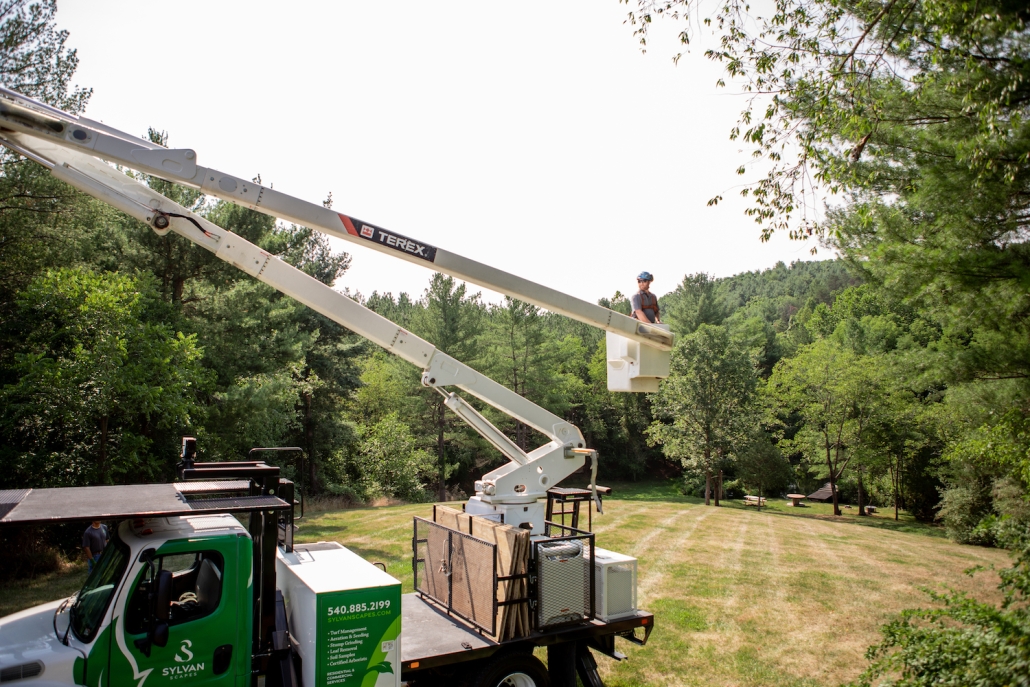
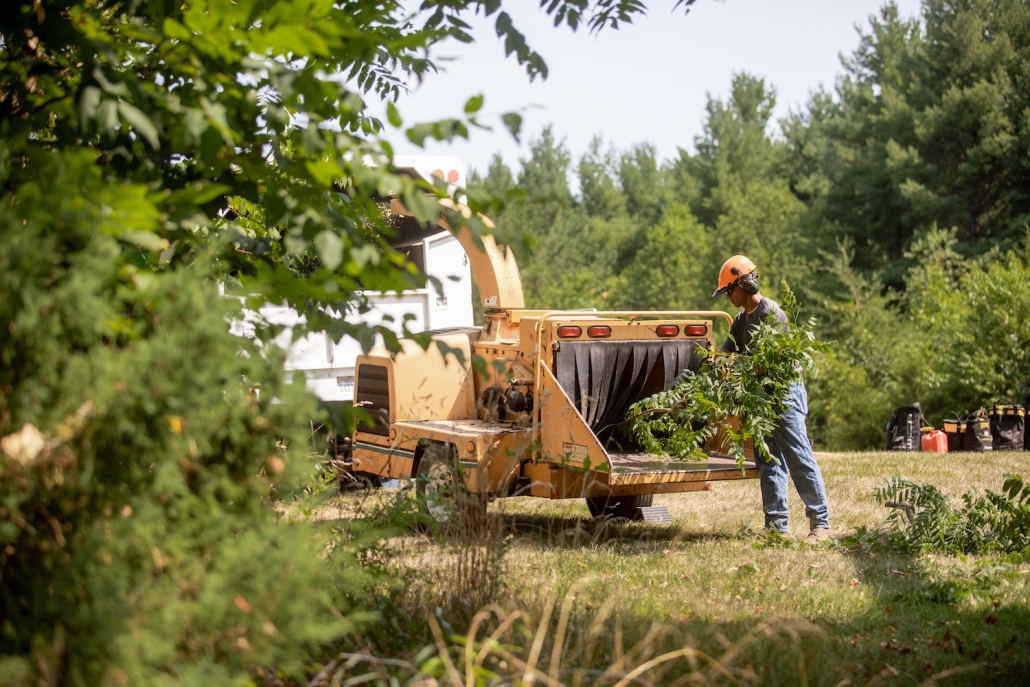
The crew starts with a walk-around to confirm the plan, the drop zones, and what needs protecting. For a tree in the open, they may fell it in one or two large pieces. For a tree near a house, fence, or power line, a climber or bucket operator takes it down in sections, rigging and lowering each piece by rope so nothing falls where it should not. Branches feed into a chipper as they come down, and the trunk is cut into manageable logs. Then comes cleanup, raking the debris, clearing the chips, and leaving the area tidy. The last decision is the stump: grind it now or leave it. Settling that during the estimate keeps the day moving and the final bill clear.
Why a certified arborist's estimate is different
Here is the part that separates a real estimate from a number scribbled on a truck door. Sylvan Scapes has an ISA Certified Arborist on the team, along with the CTSP (Certified Treecare Safety Professional) credential through the TCIA. That means the people quoting and doing your work are held to a documented code of ethics and industry safety standards, not just whoever answered the phone.
We have served Staunton and the Shenandoah Valley since 2003, and we are licensed and insured, which protects you if anything goes sideways during a removal. Owner Kevin Thompson is personally involved in estimating and scheduling, so the person sizing up your tree is the person standing behind the work. We cover Augusta County, Albemarle County, Rockingham County, and the Charlottesville area, and every estimate starts with a free on-site visit.
An uninsured crew that underbids the job can cost you far more than the difference if a limb lands on your roof or a worker is hurt on your property. The cheap quote is rarely the cheap outcome.
How to get an accurate tree removal quote in the Valley
You cannot price a tree removal from a photo and a phone call, and you should be wary of anyone who tries. An accurate quote needs eyes on the tree, the access, and the targets around it.
To get the most useful estimate, do three things. Walk the property with the estimator and point out the trees you are worried about. Ask specifically what the price includes, stump, haul-away, and cleanup. And confirm the company is insured before any saw starts running. When you are ready, call Sylvan Scapes at (540) 885-2199 or request your free estimate online, and we will get a real number on the table for your property in Staunton, Augusta County, or anywhere across the Valley we serve.
Frequently asked questions
How much does it cost to remove a large tree in Virginia? A large tree of 60 to 80 feet usually runs about $800 to $1,500, and very large or hazardous trees over 80 feet can reach $1,500 to $3,000 or more. Price depends on access and what the tree is sitting over. A free on-site estimate is the only way to get an exact figure.
Does the tree removal price include stump grinding? Usually not. Tree removal and stump grinding are typically priced as separate line items, so ask whether the stump is included. If you want it gone, tell your estimator up front so it is built into the quote.
Is emergency tree removal more expensive than a scheduled job? Yes. Storm and after-hours work runs higher than planned removals because of the urgency, the added risk, and the off-schedule crew. If a tree is on your home or blocking access, call right away rather than waiting.
Will my homeowners insurance cover tree removal? Sometimes. Insurance often helps when a tree falls on a covered structure, but routine removal of a healthy or simply dead tree is usually on the homeowner. Check your policy and document any storm damage before cleanup begins.
Can a tree be saved instead of removed? Often, yes. Cabling, bracing, pruning, and pest or disease treatment can keep a structurally sound tree standing and safe. A certified arborist can tell you whether removal is truly necessary or whether a less expensive option will do.
How do I get an accurate tree removal estimate near Staunton? Schedule a free on-site visit so an arborist can assess size, access, condition, and surroundings. Call Sylvan Scapes at (540) 885-2199 or request an estimate online, and we will price the job for your property anywhere in Augusta County, Albemarle County, Rockingham County, or the Charlottesville area.
Ready for a real number on your tree? Call Sylvan Scapes at (540) 885-2199 or request your free estimate online. Our ISA Certified Arborist will assess your tree on site and give you an honest quote, no pressure, no guesswork. Proudly serving Staunton, Augusta County, Albemarle County, Rockingham County, and the Shenandoah Valley since 2003.