A dead tree in your yard is not a problem you can put off, and the cost of removing one usually runs $150 to $1,600 depending on size, with large or hazardous trees climbing past $2,000. Here is the part most homeowners miss: a dead tree often costs more to remove than a living one the same size, because dead wood is brittle, unpredictable, and dangerous to climb.
| Dead tree size | Typical height | Estimated dead tree removal cost |
|---|---|---|
| Small | Up to 30 ft | $150 – $450 |
| Medium | 30 – 60 ft | $400 – $900 |
| Large | 60 – 80 ft | $800 – $1,600 |
| Very large or hazardous | 80 ft+ | $1,500 – $3,000+ |
Those are estimates for properties around Staunton and Augusta County, not firm quotes. What follows is why a dead tree carries a risk premium, what it actually costs by size, and why every week you wait raises the odds of a much bigger bill.
How much does dead tree removal cost?
For a small dead ornamental in an open yard, you are usually at the low end, a few hundred dollars. For a large dead hardwood near your house or a power line, you are into four figures. The tree being dead does not lower the price the way people expect. In many cases it raises it.
Sylvan Scapes has published local tree removal ranges that put routine jobs around Staunton between roughly $169 and $700, with larger and more complex removals costing more. A dead tree tends to land on the higher side of a given size band because of how the work has to be done.
Keep in mind that the removal price and the stump are usually separate. Once a dead tree is down, the stump stays unless you ask for grinding, which is priced on its own. Debris haul-away is worth confirming too, since some crews leave the wood behind. When you get your estimate, ask what the number covers so you are comparing the same scope from one company to the next. For a fuller breakdown of what drives a removal price, see our tree removal cost guide for Virginia.
Why dead trees can cost more to remove
A healthy tree is predictable. A climber can trust the limbs, the crew can rig from solid wood, and pieces come down where they are supposed to. A dead tree offers none of that certainty.
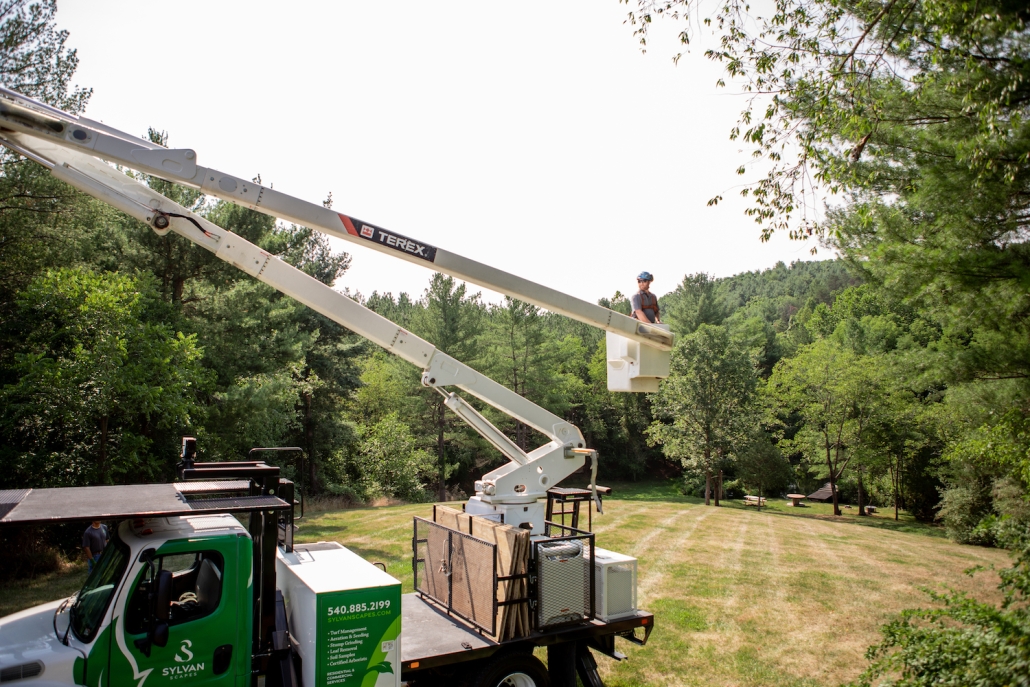
Dead wood is brittle and hollow in spots you cannot see from the ground. A limb that looks solid can snap under a climber's weight, so a good crew will not send someone up a dead tree if there is any doubt. That pushes the job toward a bucket truck or a crane, which costs more than a straightforward climb. Rigging points that would hold on a living tree may be rotten, so the crew has to work slower and lower smaller sections. All of that adds time, equipment, and care, and care is exactly what you are paying for when a tree cannot be trusted to behave.
Dead tree removal cost by size
Here is how those factors usually shake out across sizes for yards in Staunton, Augusta County, and the wider Shenandoah Valley.
Small dead trees (up to 30 feet): young or ornamental trees. Often a quick job even when dead, roughly $150 to $450 depending on access.
Medium dead trees (30 to 60 feet): mid-size trees that usually need a bucket or careful climb. Plan for $400 to $900.
Large dead trees (60 to 80 feet): full-grown hardwoods and pines. More rigging and often a bucket or crane, which puts them around $800 to $1,600.
Very large or hazardous dead trees (80 feet and up): big old trees, or any dead tree threatening a structure or line. These can run $1,500 to $3,000 or more, especially when a crane is the only safe option.
How to tell a tree is actually dead
Before you pay to remove anything, it helps to confirm the tree is truly gone rather than just stressed. A few signs point to a dead or dying tree.
Look for bare branches when the tree should be in full leaf, bark that is peeling away in large sheets or missing entirely, and brittle twigs that snap cleanly instead of bending. Fungus or mushrooms growing on the trunk or at the base often signals internal rot. A sudden lean, cracks in the trunk, or heaving soil at the root flare are warning signs the tree is failing structurally. If you scratch a small twig and the layer underneath is brown and dry rather than green and moist, that branch is dead.
Not every struggling tree needs to come down. Some can be saved with pruning or treatment once an arborist figures out what is wrong. Our arbor services team can tell you whether your tree is dead, dying, or just having a rough season.
Dead or dying? When a tree can still be saved
There is a real difference between a tree that is dead and one that is declining, and knowing which you have can save you the cost of a full removal. A dead tree has to go. A dying tree sometimes has a path back.
Trees under stress from drought, compacted soil, construction damage, or a treatable pest often look worse than they are. A maple dropping leaves early in a dry Shenandoah Valley summer is not the same as a maple that is dead. Correct pruning can remove failing limbs and take weight off a weak spot. Targeted treatment can knock back borers or a fungal problem before it spreads. Soil work and proper watering can pull a stressed tree back over a season or two. The point is that removal is not always the answer, and a certified arborist earns the call by telling you when it is not.
When a tree genuinely cannot be saved, waiting only raises the price and the risk. The skill is knowing the difference, and an on-site assessment settles it.
Why waiting to remove a dead tree costs more
This is the real cost of a dead tree, and it is not on the invoice. Every month a dead tree stands, it gets more dangerous and less predictable, and the price of ignoring it can dwarf the price of removing it.
| The risk | What it means for you |
|---|---|
| Falling limbs | Dead branches drop without warning onto cars, roofs, fences, and people |
| Full collapse | A dead trunk can come down in a storm and take out a structure |
| Pest spread | Beetles, borers, and carpenter ants nest in dead wood and move to healthy trees nearby |
| Liability | If a dead tree you knew about falls on a neighbor's property, you may be on the hook |
| Insurance denial | Damage from a tree that died of neglect is often not covered |
That last one matters more than people realize. If a storm knocks down a healthy tree, your policy may help. If the tree was already dead and you left it, an insurer can treat that as a maintenance failure and deny the claim. Waiting does not just risk damage. It risks paying for that damage yourself. We cover how coverage works in our guide on whether homeowners insurance covers tree removal.
Is a dead tree an emergency?
Sometimes, yes. A dead tree leaning over your house, hanging above a driveway, or resting against a power line is not something to schedule for next month. Those situations can turn into property damage or worse with the next strong wind, and they call for prompt removal. Our guide to emergency tree removal after a storm walks through what counts as urgent.
A dead tree standing alone in a back corner of the yard, well clear of anything it could hit, is less urgent but still worth handling before it starts dropping limbs. The safe rule: the closer a dead tree is to people, structures, or lines, the sooner it needs to come down.
Why hire a certified arborist for a dead tree
A dead tree is the exact job where cutting corners gets expensive. Sylvan Scapes has an ISA Certified Arborist on the team along with the CTSP (Certified Treecare Safety Professional) credential through the TCIA, so the person assessing your tree knows the difference between dead, dying, and recoverable, and the crew knows how to bring an unstable tree down safely.
We have served Staunton and the Shenandoah Valley since 2003, we are licensed and insured, and owner Kevin Thompson is personally involved in estimating and scheduling. We work throughout Augusta County, Albemarle County, Rockingham County, and the Charlottesville area. An uninsured crew that misjudges a brittle tree can turn a routine removal into a claim against your property, which is the opposite of saving money.
Get a free dead-tree assessment near Staunton
If you have a tree you suspect is dead, the smart first move is a professional look before a branch decides for you. Every estimate starts with a free on-site assessment, and you get an honest answer about whether the tree needs to come down and what it will cost. Not sure the tree is even dead? That is exactly what the visit is for. We would rather tell you a tree can be saved than sell you a removal you do not need. Call (540) 885-2199 or request your assessment online, and we will get out to your property anywhere across Augusta County and the Valley.
Frequently asked questions
How much does it cost to remove a dead tree? Most dead tree removals run $150 to $1,600 depending on size, and very large or hazardous trees can exceed $2,000. Dead trees often cost a bit more than living trees the same size because brittle wood forces a slower, rigged removal or a crane. A free on-site estimate gives you an exact number.
Why is dead tree removal more expensive than removing a live tree? Dead wood is brittle and unpredictable, so a crew cannot safely climb or rig it the way they would a solid tree. That often means a bucket truck or crane and slower, more careful work, which adds to the cost.
Is it dangerous to leave a dead tree standing? Yes. Dead trees drop limbs without warning, can collapse in a storm, and attract pests that spread to healthy trees. A dead tree you knew about can also create liability if it falls on someone else's property.
Will homeowners insurance pay to remove a dead tree? Usually not. Insurers treat a tree that died from disease, age, or neglect as maintenance, so removal is typically the homeowner's expense. Coverage may apply only in narrow storm situations, so check your policy.
How can I tell if my tree is dead or just dormant? Scratch a small twig. Green and moist underneath means it is alive; brown and dry means that branch is dead. Bare limbs in the growing season, peeling bark, brittle twigs, and fungus at the base all point to a dead or dying tree. An arborist can confirm it.
How soon should I remove a dead tree? Sooner is cheaper and safer. The longer a dead tree stands, the more brittle and unpredictable it becomes, and the higher the odds of property damage or a denied insurance claim. Schedule an assessment as soon as you suspect a tree has died.
Worried about a dead tree on your property? Call Sylvan Scapes at (540) 885-2199 or request your free assessment online. Our ISA Certified Arborist will check the tree on site and give you an honest recommendation, no pressure. Proudly serving Staunton, Augusta County, Albemarle County, Rockingham County, and the Shenandoah Valley since 2003.