The Essential Guide to Professional Golf Turf Management
What Is Golf Turf Management — and Why Does It Matter?
Golf turf management is the science and practice of growing, maintaining, and optimizing turfgrass on golf courses to deliver consistent playability, visual appeal, and long-term turf health.
Here’s a quick breakdown of the core elements:
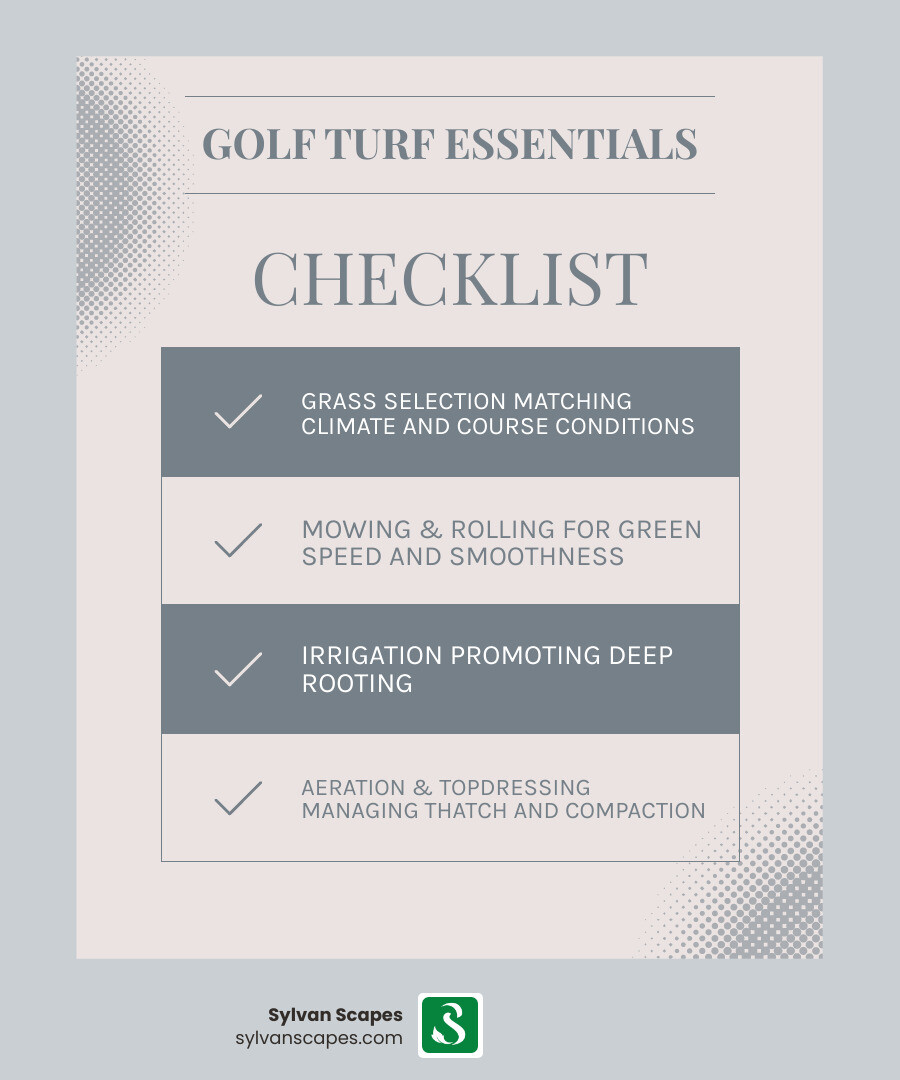
| Element | What It Covers |
|---|---|
| Grass selection | Matching species to climate and course conditions |
| Mowing & rolling | Controlling green speed, surface smoothness, and plant health |
| Irrigation | Deep rooting through strategic watering schedules |
| Aeration & topdressing | Managing thatch, compaction, and organic matter |
| Pest & disease control | Integrated management to reduce chemical reliance |
| Seasonal planning | Adapting maintenance tasks to spring, summer, fall, and winter |
Golf course greens are the heart of the game. Whether it’s bentgrass in the Northeast or bermudagrass in the South, the quality of the putting surface defines the player experience — and the course’s reputation.
Getting it right takes more than a mowing schedule. It takes agronomic science, the right equipment, and a deep understanding of how soil, climate, water, and plant biology all interact.
I’m Kevin Thompson, founder of Sylvan Scapes and a certified arborist with over two decades of hands-on grounds and turf maintenance experience serving properties across Virginia’s Shenandoah Valley — and the principles behind professional golf turf management directly inform the turf care standards we bring to every commercial and residential property we manage. Whether you’re curious about adapting these techniques to your own lawn or simply want to understand what separates average grass from championship-quality turf, this guide breaks it all down in plain language.
The Science of Golf Turf Management: Grass Types and Climates
When we talk about golf turf management in areas like Staunton, Charlottesville, and throughout Augusta or Albemarle County, we are playing in what experts call the “Transition Zone.” This means our weather is often too hot for some cool-season grasses and too cold for some warm-season ones. Choosing the right grass isn’t just a matter of aesthetics; it’s about survival and performance.
The Heavy Hitters: Common Grass Species
In professional golf, four names come up more than any others:
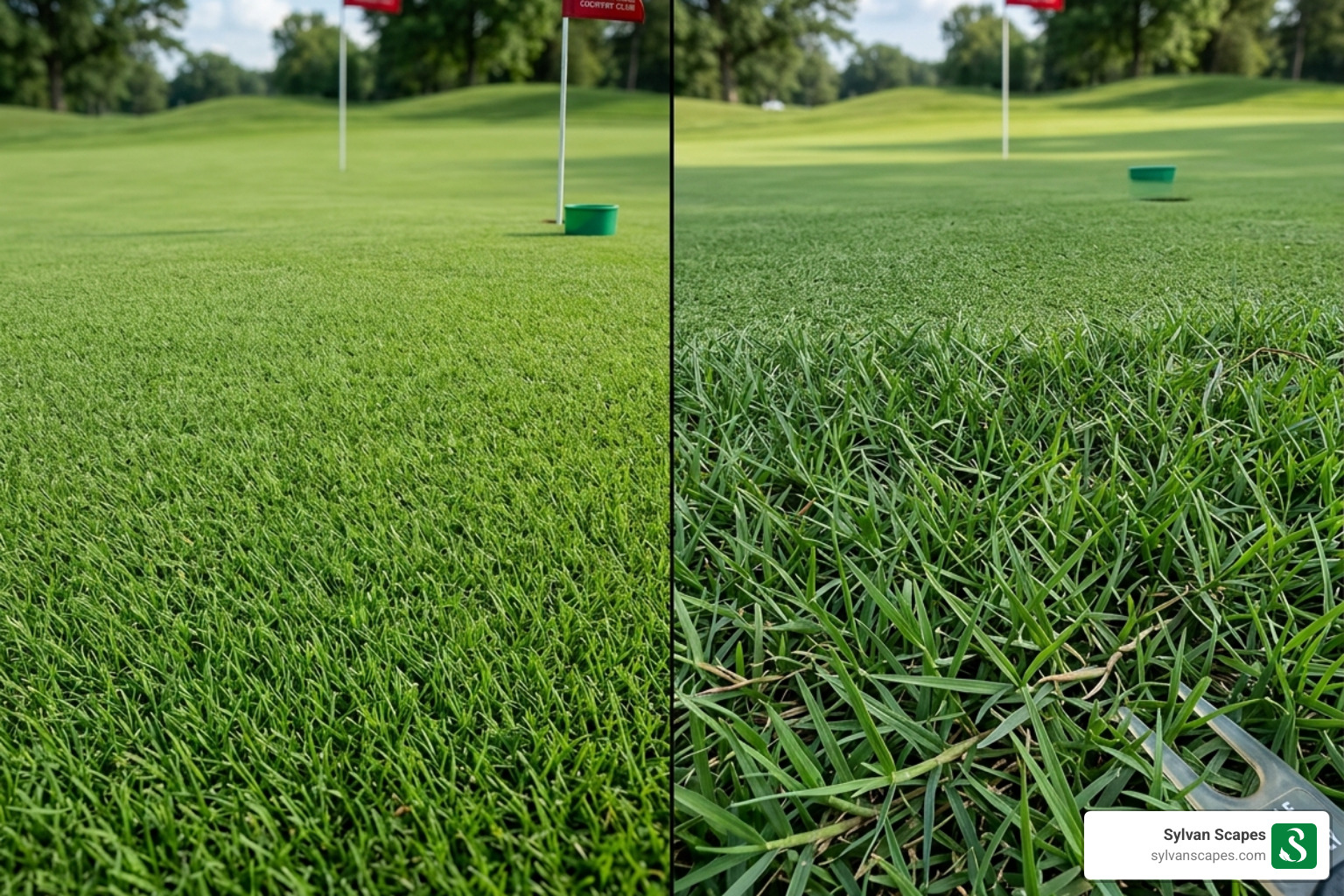
- Creeping Bentgrass: This is the gold standard for putting greens in the North and the Transition Zone. It has a fine texture and can tolerate incredibly low mowing heights. However, it’s a bit of a “diva”—it loves cool nights and can struggle during our humid Virginia summers without careful moisture management.
- Bermudagrass: A warm-season powerhouse. It thrives when the sun is beating down and temperatures soar above 90°F. While it’s incredibly durable for fairways and tees, it goes dormant and turns brown in the winter, which requires “overseeding” if a green look is desired year-round.
- Poa Annua (Annual Bluegrass): Often considered an invasive weed in home lawns, Poa annua is actually managed as a primary putting surface on many historic courses. It provides a very smooth ball roll but is susceptible to disease and heat stress.
- Zoysiagrass: Known for its carpet-like feel, Zoysia is increasingly popular for fairways because it requires less water and nitrogen than other species while providing a fantastic “perched” lie for the golf ball.
Climate Adaptation and Seed Selection
Selecting the right cultivar is a high-stakes decision. Superintendents look at USDA Hardiness Zones and regional performance data to ensure the grass can handle local pests and weather patterns. For those of us in the Shenandoah Valley, we often look to research from programs like the Golf turf | Cornell Turfgrass Program to understand how different varieties hold up against regional challenges.
| Feature | Cool-Season (Bentgrass/Bluegrass) | Warm-Season (Bermuda/Zoysia) |
|---|---|---|
| Ideal Growth Temp | 60°F – 75°F | 80°F – 95°F+ |
| Drought Tolerance | Moderate to Low | High |
| Winter Color | Stays green longer | Goes dormant (brown) |
| Mowing Height | Can be kept extremely low | Varies by species |
Essential Maintenance for High-Performance Greens
If the grass is the canvas, then mowing and irrigation are the brushes. To achieve that lightning-fast green speed golfers crave, golf turf management requires precision that would make a Swiss watchmaker jealous.
Mowing Heights and Green Speed
Green speed is measured using a device called a Stimpmeter—a simple ramp that releases a ball at a consistent velocity. A “fast” green might measure 11 or 12 feet, while daily play usually hovers around 9 or 10.
To get these speeds, mowing heights are pushed to the limit. For daily play, greens are often cut between 0.125″ and 0.140″. During tournaments, that height might drop to a razor-thin 0.100″. However, cutting that low puts immense stress on the plant. To compensate, superintendents often use “rolling” (using a heavy mechanical roller) to smooth the surface and increase speed without having to lower the blades further.
Irrigation Strategies
The goal of watering a golf course isn’t just to keep it green; it’s to keep it healthy. We advocate for “deep and infrequent” watering. By allowing the soil to dry out slightly between sessions, we encourage the roots to grow deeper in search of moisture. This builds a hardy plant that can survive a Virginia heatwave. Many pros now use soil moisture meters to get real-time data, ensuring they only apply water exactly where and when it’s needed. For a deeper dive into these technicalities, the How to Maintain Golf Course Greens: Seed, Divot Repair, and Seasonal Care Guide is an excellent resource.
Daily and Seasonal Golf Turf Management Tasks
Maintaining a golf course is a 365-day-a-year job. While golfers see the mowers every morning, much of the most important work happens behind the scenes or during the “off-season.”
- Daily: This includes mowing, changing hole locations to prevent wear, and the constant battle of divot repair and ball mark restoration.
- Weekly/Monthly: This often involves “topdressing”—applying a thin layer of sand to the greens. This helps dilute thatch (the layer of organic debris between the grass and the soil) and keeps the surface firm and smooth.
- Seasonally: This is when the heavy lifting happens. Core aeration is the process of pulling small “plugs” out of the ground to allow oxygen, water, and nutrients to reach the root zone. While it’s a temporary headache for players, it’s vital for long-term health. We use similar high-end techniques in our Staunton Landscaping Company Turf Maintenance services to ensure local lawns stay vibrant and compacted-free.
Integrated Pest Management and Sustainability
Modern golf turf management has moved far away from the “spray everything” mentality of the past. Today, the focus is on Integrated Pest Management (IPM). This means we use a combination of biological, mechanical, and chemical tools to keep the turf healthy while protecting our local water resources.
Disease and Weed Control
In the Shenandoah Valley, humidity is our biggest enemy. It invites diseases like Dollar Spot (small, silver-dollar-sized bleached spots) and Pythium Blight (which can destroy a green in hours if left unchecked).
By using the research-based tools from the Cornell Turfgrass Program, superintendents can predict disease outbreaks based on weather data and apply preventative treatments only when necessary. This proactive approach is exactly how we handle residential care, as seen in our guide on How Top Turf Lawn Care And Pest Control Beats The Competition.
Advanced Golf Turf Management for Tournaments
Preparing for a tournament is like tuning a race car. It’s a delicate balance of firmness, smoothness, and trueness. If a green is too soft, the ball won’t roll predictably; if it’s too hard, it won’t “hold” a shot.
Superintendents manage “performance ranges” by strictly controlling moisture and organic matter months in advance. The goal is uniformity—every green on the course should play exactly like the one before it. For those interested in the physics of the perfect putt, check out A Practical Guide for Maintaining Green Speed and Firmness – Turfgrass.
Career Paths and Professional Equipment
The people behind the pristine fairways are highly trained professionals. It’s a field that combines biology, chemistry, and business management.
- The Roles: A Golf Course Superintendent is the “CEO” of the outdoor space, often managing budgets in the millions. They are supported by Assistant Superintendents, Equipment Managers, and specialized spray technicians.
- The Rewards: According to industry data, the average base salary for a golf course superintendent is approximately $97,354, with those holding specialized two-year certificates often earning even more.
- The Education: With a job placement rate of over 95%, programs at schools like Penn State and Mississippi State are booming. They focus on everything from soil science to “STEM” applications in turf. You can learn more about these educational pathways through the Sports Fields and Golf Course Turf | Penn State Extension.
Professional equipment is also a major investment. A fleet of reel mowers (which cut like scissors rather than the “chopping” action of a standard rotary mower), aerators, and precision sprayers can easily cost a club hundreds of thousands of dollars.
Frequently Asked Questions about Golf Turf
How can homeowners adapt golf course techniques for residential lawns?
You don’t need a million-dollar budget to have a “golf quality” lawn in Staunton or Charlottesville. The secret lies in the fundamentals:
- Mowing Frequency: Golf courses mow daily; you should aim for every 3-4 days during the peak growing season. Never remove more than one-third of the grass blade at once.
- Sharp Blades: This is non-negotiable. Dull blades tear the grass, leaving it brown and susceptible to disease.
- Deep Watering: Water 1-1.5 inches per week in two deep sessions rather than light daily sprinkling.
- Slow-Release Fertilizer: This prevents “surge growth” and keeps the color consistent.
For those looking to start fresh with a professional surface, we’ve put together a guide on How To Get The Best Sod Installation In Staunton Without Breaking A Sweat. You can also find more tips in the Golf Course Quality Lawn: A Golfer’s Guide | Golf Edge.
What is the difference between core aeration and solid tining?
- Core Aeration: Pulls a physical “plug” of soil and thatch out of the ground. This is best for reducing compaction and managing heavy thatch buildup.
- Solid Tining: Pokes a hole without removing soil. It’s less disruptive to the playing surface and is great for getting oxygen to the roots mid-season without ruining a weekend of golf.
How do you properly repair a ball mark on a green?
Please, for the love of the game, stop “lifting” the turf!
- Insert your ball mark tool at the edge of the depression.
- Push the turf toward the center of the mark.
- Work your way around the circle, pushing inward.
- Gently tamp it down with your putter. Lifting the soil tears the roots and leaves a brown spot that takes weeks to heal. Pushing it inward allows the grass to knit back together almost overnight.
Conclusion
At Sylvan Scapes, we believe that every landscape—whether it’s a championship golf course or a family backyard in Rockingham County—deserves professional-grade care. Golf turf management teaches us that the best results come from a balance of high-tech science and consistent, “boots-on-the-ground” hard work.
By understanding the needs of the plant, the composition of the soil, and the challenges of our Virginia climate, we can create outdoor spaces that are not only beautiful but sustainable and resilient. If you’re ready to take your property’s turf to the next level, our team is here to help with professional Staunton Commercial Landscaping Company Turf Maintenance. Let’s work together to make the Shenandoah Valley a little greener, one acre at a time.