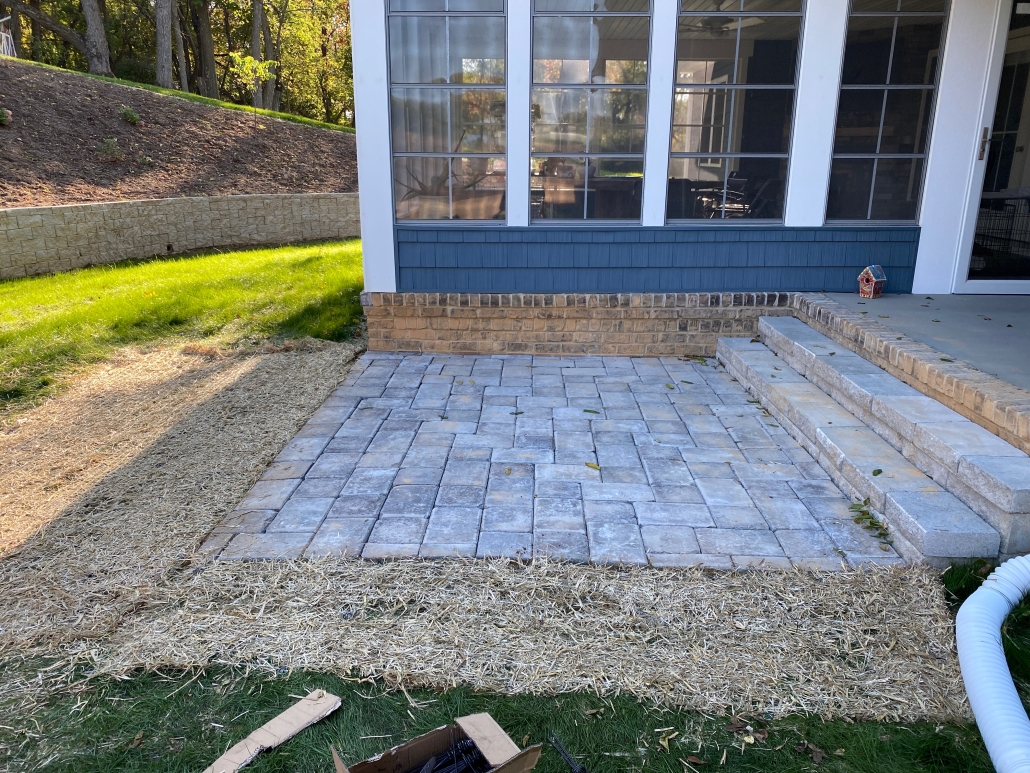
Why So Many Homeowners Are Searching for Paver Patio Installation Companies Near Me

If you’re looking for paver patio installation companies near me, here’s what you need to know upfront:

  • Pavers outlast concrete and asphalt and can last 100+ years with proper installation
  • Costs vary based on square footage, material type, site access, and base preparation
  • What to look for in a company: licensing, insurance, ICPI certification, portfolio, and warranty
  • Typical project timelines: small walkways take 1-2 days; full patios and driveways take 3-7 days
  • Free estimates are standard — always get at least 2-3 quotes before committing

A paver patio does more than look good. It adds usable outdoor living space, boosts curb appeal, and holds up to the kind of wear that cracks concrete slabs over time. According to the NAR Remodeling Impact Report on Outdoor Features, a $10,000 wood deck recovers around $8,000 at resale — and a well-installed paver patio can perform even better long-term because it requires far less ongoing maintenance.

The challenge is knowing who to call and what to ask before you sign anything.

I’m Kevin Thompson, founder of Sylvan Scapes and an ISA Certified Arborist who has been building and maintaining outdoor spaces across Virginia’s Shenandoah Valley since 2003 — including hardscaping projects where the right paver patio installation company near me made all the difference for our clients. That hands-on experience is what shapes everything in this guide.

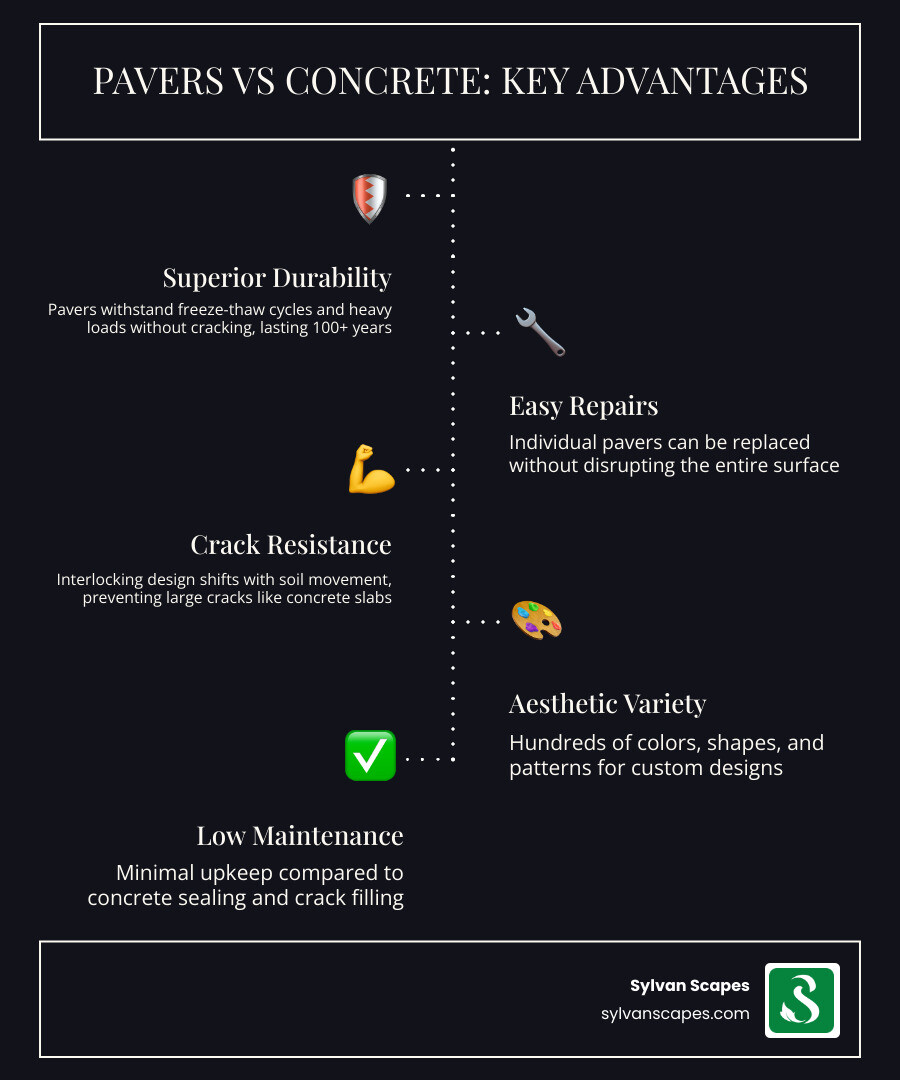
Benefits of pavers vs concrete comparison infographic showing durability, cost, maintenance, and lifespan - paver patio

Why Homeowners Prefer Paver Patio Installation Companies Near Me

When you start looking for paver patio installation companies near me, the first question you might ask is: “Why not just pour a concrete slab?” It’s a fair question. Concrete is often the default choice, but in the Shenandoah Valley, our soil and climate (especially the freeze-thaw cycles) can be brutal on solid surfaces.

Durability and Compressive Strength

Interlocking concrete pavers are engineered to be incredibly strong. They have a higher compressive strength than standard poured concrete, meaning they can handle more weight without failing. While a concrete slab is a single, rigid piece that must crack when the ground shifts, a paver system is flexible. Because there are joints between every stone, the patio can “breathe” and move slightly with the soil as it freezes and thaws. This prevents the unsightly, jagged cracks that plague so many Virginia driveways and backyards.

Easy Repairs and Longevity

If a tree root grows under a concrete patio, you usually have to jackhammer the whole thing out to fix it. With pavers, we can simply lift the affected stones, fix the base or the root, and lay the exact same stones back down. It’s a seamless repair. Research shows that while the upfront cost of pavers might be higher than asphalt or concrete, the long-term costs are significantly lower because you aren’t replacing the entire surface every 15 to 20 years. In fact, properly installed pavers can last a century.

Feature Paver Patios Poured Concrete Wood Decks
Lifespan 50 – 100+ Years 15 – 25 Years 10 – 20 Years
Maintenance Low (Sweep/Seal) Medium (Patching) High (Stain/Sand)
Repairability Excellent (Individual) Poor (Requires Patch) Moderate
Crack Risk Extremely Low High N/A
ROI High Moderate Moderate (80%)

Aesthetic Variety

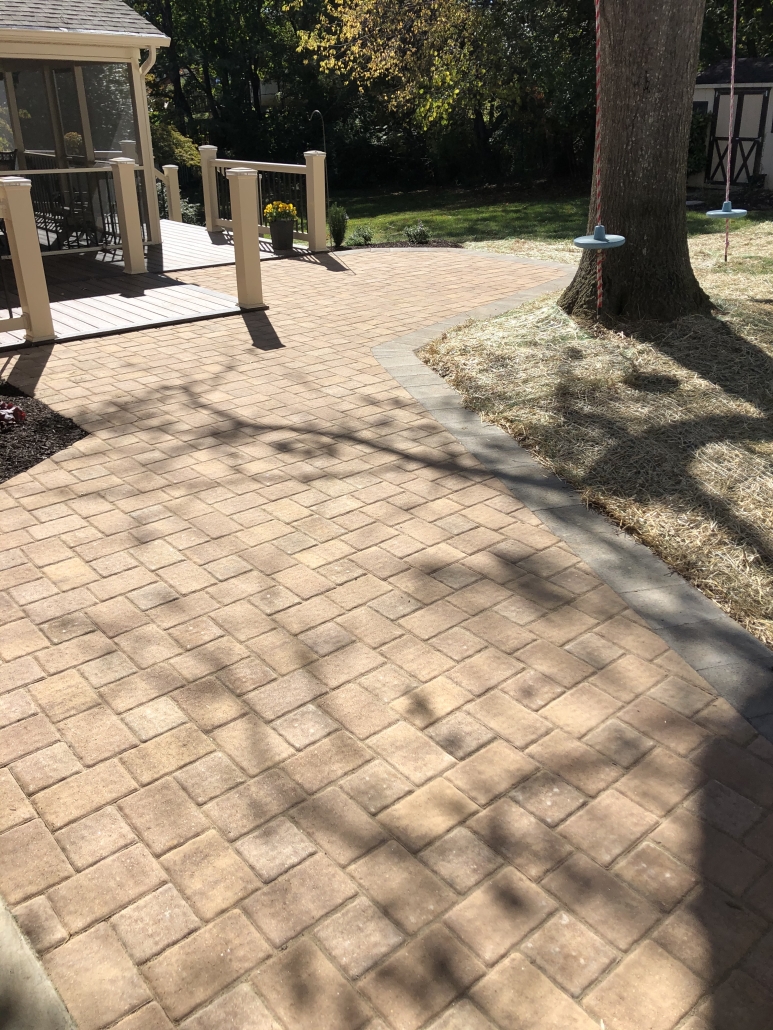
When you hire professional paver patio installation companies near me, you aren’t limited to a gray rectangle. You have access to a massive palette of colors, shapes, and textures. Whether you want the look of old-world cobblestone, sleek modern porcelain, or rustic natural stone, pavers can be laid in intricate patterns like herringbone, basketweave, or running bond to complement your home’s architecture.

Enhancing Home Value and Outdoor Living

According to the Remodeling Impact Report: Outdoor Features, outdoor upgrades are among the best ways to recoup your investment. Beyond the financial ROI, there’s the “joy score”—the satisfaction of having a functional space for grilling, fire pits, and family gatherings.

We often see homeowners struggle with “landscape reclamation” after a major construction project. A professional team doesn’t just lay stones; they ensure the surrounding yard is restored. By creating multi-level designs or integrating seating walls, we can turn a sloped, unusable backyard in Charlottesville or Staunton into a series of functional “rooms.” You can see examples of these transformations in our Portfolio Entries Hardscapes.

Understanding Costs and Material Options

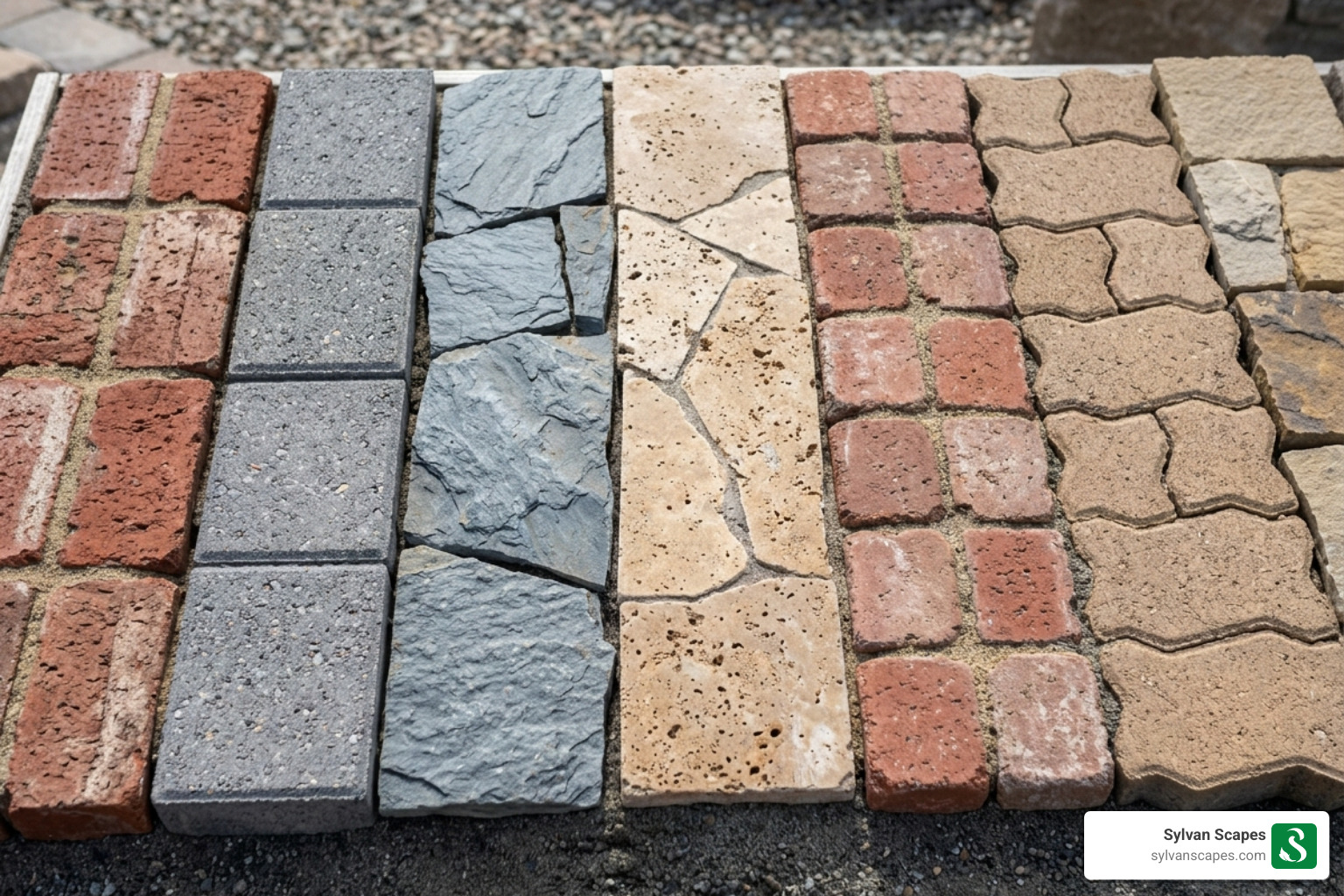
Various types of pavers including brick, concrete, and natural stone styles - paver patio installation companies near me

One of the most common reasons people search for paver patio installation companies near me is to get a handle on pricing. While every site is different, several key factors influence your final quote.

  1. Square Footage: The size of the area is the primary driver of cost.
  2. Material Choice: Basic concrete pavers are the most affordable, while natural stone (like travertine or slate) and specialized porcelain pavers sit at the higher end of the spectrum.
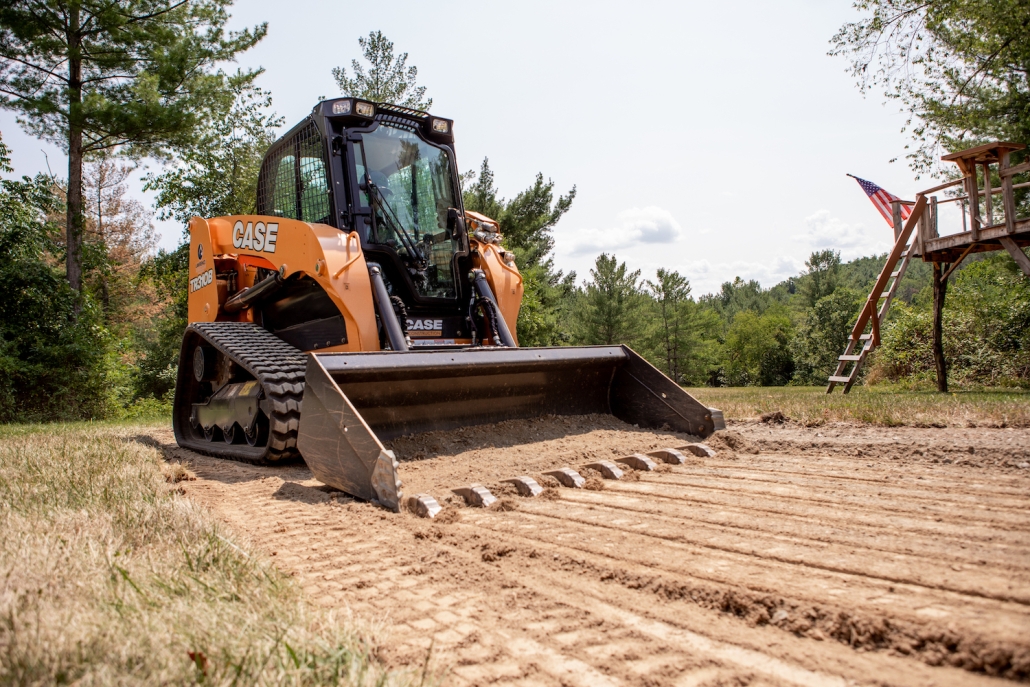
  3. Site Access: Can we get a skid-steer or excavator into your backyard? If we have to move tons of dirt and stone by hand through a narrow gate, labor costs will rise.
  4. Base Preparation: If your soil is heavy clay (common in Augusta and Rockingham counties), we may need to excavate deeper and add more aggregate base to ensure stability.
  5. Permitting: Depending on your local municipality in Keswick or Albemarle County, permits may be required for drainage or structural walls.

Choosing Materials with Paver Patio Installation Companies Near Me

When you consult with us, we’ll walk you through the pros and cons of different materials:

  • Concrete Pavers: The most popular choice. They are uniform, making installation faster, and come in styles that mimic natural stone or brick.
  • Brick Pavers: Made of clay, these offer a classic, timeless look. They are exceptionally colorfast and won’t fade under the Virginia sun.
  • Natural Stone: Materials like flagstone or travertine offer a unique, high-end look. No two stones are exactly alike.
  • Porcelain Pavers: A growing trend for 2024. They are incredibly durable, slip-resistant, and won’t absorb stains from grease or wine.
  • Permeable Pavers: These are an eco-friendly option designed with larger joints to allow rainwater to soak directly into the ground. This reduces runoff and helps prevent local drainage issues or “pooling” on your property.

The Professional Installation Process

If you’ve ever seen a “sinking” paver patio, it’s almost always because of poor installation. Professional paver patio installation companies near me follow a rigorous, multi-step process to ensure the surface stays flat for decades.

1. Excavation and Grading

We don’t just clear the grass. For a standard patio, we typically excavate 7 to 10 inches deep. For driveways, this can go up to 14 inches. The most critical part here is the “pitch”—we ensure the ground slopes away from your home’s foundation (usually 1 inch of drop for every 8 to 10 feet of distance) so water doesn’t end up in your basement.

2. Sub-grade Compaction and Geotextile Fabric

Once the soil is exposed, we compact it using heavy machinery. We then lay down a layer of geotextile fabric. This “separation layer” prevents the expensive stone base from sinking into the soft Virginia clay over time, while still allowing water to pass through.

3. Base Aggregate and Bedding Sand

We install layers of crushed limestone (often called “Class II Baserock”). Each layer is wetted and compacted until it’s rock-hard. On top of that, we screed a 1-inch layer of sharp, angled bedding sand. This sand acts as the “cushion” that the pavers sit in.

4. Interlocking Placement and Edge Restraints

The pavers are hand-laid in your chosen pattern. Once they are down, we install edge restraints—typically heavy-duty plastic or concrete borders—to keep the pavers from “creeping” outward over time.

Why Professional Expertise Matters

Many DIYers try to skip these steps to save money, but the result is usually a patio that shifts within two years. Professional companies understand the nuances of drainage and structural integrity.

One of the most important finishing touches is the use of polymeric sand. This is regular sand mixed with special polymers. Once we sweep it into the joints and mist it with water, it hardens like glue. This prevents weeds from growing between the stones and keeps ants from making nests in your patio. It’s also flexible enough to handle the freeze-thaw cycles without cracking like mortar would. You can see the crisp, clean lines this creates in our Portfolio Entries Hardscapes.

How to Vet and Hire the Right Team

When you’re comparing paver patio installation companies near me, don’t just go with the lowest bid. A “cheap” patio often ends up being the most expensive one if you have to pay someone else to fix it three years later.

Licensing and Insurance

In Virginia, any reputable contractor should be licensed and carry both general liability and workers’ compensation insurance. This protects you if a worker is injured on your property or if your home is accidentally damaged during the excavation.

ICPI Certification

The Interlocking Concrete Pavement Institute (ICPI) is the industry standard for paver installation. Hiring a company with ICPI-certified installers ensures that your team is following best practices for base preparation and drainage—the things you can’t see but that matter the most.

Portfolio and Testimonials

Look for a local track record. A company that has been serving the Shenandoah Valley since 2003, like we have at Sylvan Scapes, understands our local soil conditions and climate. Ask to see photos of projects that are at least 5 to 10 years old. Anyone can make a patio look good on day one; the real test is how it looks after a decade of Virginia winters.

What to Ask Paver Patio Installation Companies Near Me

Before you sign a contract, ask these specific questions:

  • What is your warranty? Reputable companies usually offer at least a 5-year installation warranty, while material manufacturers often offer lifetime warranties on the stones themselves.
  • Who is doing the work? Do you use your own specialized crews, or do you sub-contract the work out to whoever is available? (At Sylvan Scapes, we believe in specialized in-house crews for better quality control).
  • How do you handle drainage? If they don’t mention grading or “pitch,” that’s a red flag.
  • What is the timeline and cleanup process? Will there be a dumpster in my driveway for weeks? How do you restore the grass after the heavy machinery leaves?

Frequently Asked Questions about Paver Patios

How long does a paver patio installation typically take?

For a standard-sized backyard patio (around 300-500 square feet), the process usually takes 3 to 7 days. Small walkways or entryways can often be completed in just 1 to 2 days. Factors like weather, site access, and the complexity of the pattern can affect this timeline.

Do paver patios require special maintenance or sealing?

Pavers are famously low-maintenance, but they aren’t “no-maintenance.” We recommend regular sweeping to keep organic debris from staining the surface. Sealing your pavers every 3 to 5 years is a great way to protect the color from UV rays and resist stains from oil or food. If a stone does get damaged, it can be replaced individually without disturbing the rest of the patio.

Are permeable pavers better for the environment?

Yes! Permeable pavers are an excellent choice for homeowners in areas like Charlottesville where stormwater management is a priority. They feature wider joints filled with small aggregate that allow water to percolate directly into the soil. This recharges the local groundwater and reduces the amount of polluted runoff entering our local streams and sewer systems.

Conclusion

Investing in a paver patio is one of the smartest ways to upgrade your home’s value and your quality of life. By choosing the right paver patio installation companies near me, you ensure that your new outdoor space is built on a solid foundation—literally.

At Sylvan Scapes, we’ve been the trusted choice for hardscaping and tree care in Staunton and the Shenandoah Valley since 2003. As an ISA Certified Arborist and CTSP-certified company, we take a holistic view of your property, ensuring your new patio integrates perfectly with your existing landscape and trees. Whether you’re in Albemarle, Augusta, or Rockingham County, we’re here to help you design a space that lasts a lifetime.

If you’re ready to transform your backyard, contact us for a consultation. We can handle everything from the initial design to the final landscape reclamation. Learn more about our services as a Staunton Hardscape Company and let’s start building your dream outdoor living area today.

What a Utility Telecommunications Lineman Actually Does (And Why It Matters)

A utility telecommunications lineman is a skilled field technician who installs, maintains, and repairs overhead and underground telecommunications infrastructure – including fiber optic lines, coaxial cable, and strand – on utility poles and aerial spans across multiple states.

Here’s a quick overview of what these roles involve:

Role Pay Range Travel Key Skills
Telecommunications Lineman (Muncie, IN) $20-$26/hr 75% Pole climbing, bucket truck, fiber/coax
Telecommunications Lineman (Pittsburgh, PA) $23-$27/hr 75% CATV lines, aerial plant, engineering plans
Fiber Lineman (Ohio, statewide) $25-$30/hr Up to 100% Fiber construction, NESC compliance, GIS
Utility Pole Technician (Central U.S.) Not listed 75-100% Pole inspection, steel truss, excavation

These aren’t just hard hats and climbing boots. Utility linemen handle everything from fiber upgrades and copper wire removal to storm recovery – like restoring service across 86 areas of Hamilton County after tornadoes knocked out connectivity.

The work is demanding, technically complex, and essential to keeping communities connected.

I’m Kevin Thompson, founder of Sylvan Scapes and an ISA Certified Arborist based in Staunton, Virginia – and while my crews focus on trees, not telecom, my years working around utility rights-of-way and infrastructure corridors give me a grounded perspective on what utility telecommunications lineman work really looks like in the field. This guide breaks down everything you need to know, from daily responsibilities and safety protocols to pay, benefits, and career growth.

For readers who want a broader overview of utility line safety standards, the National Electrical Safety Code is a helpful reference point.

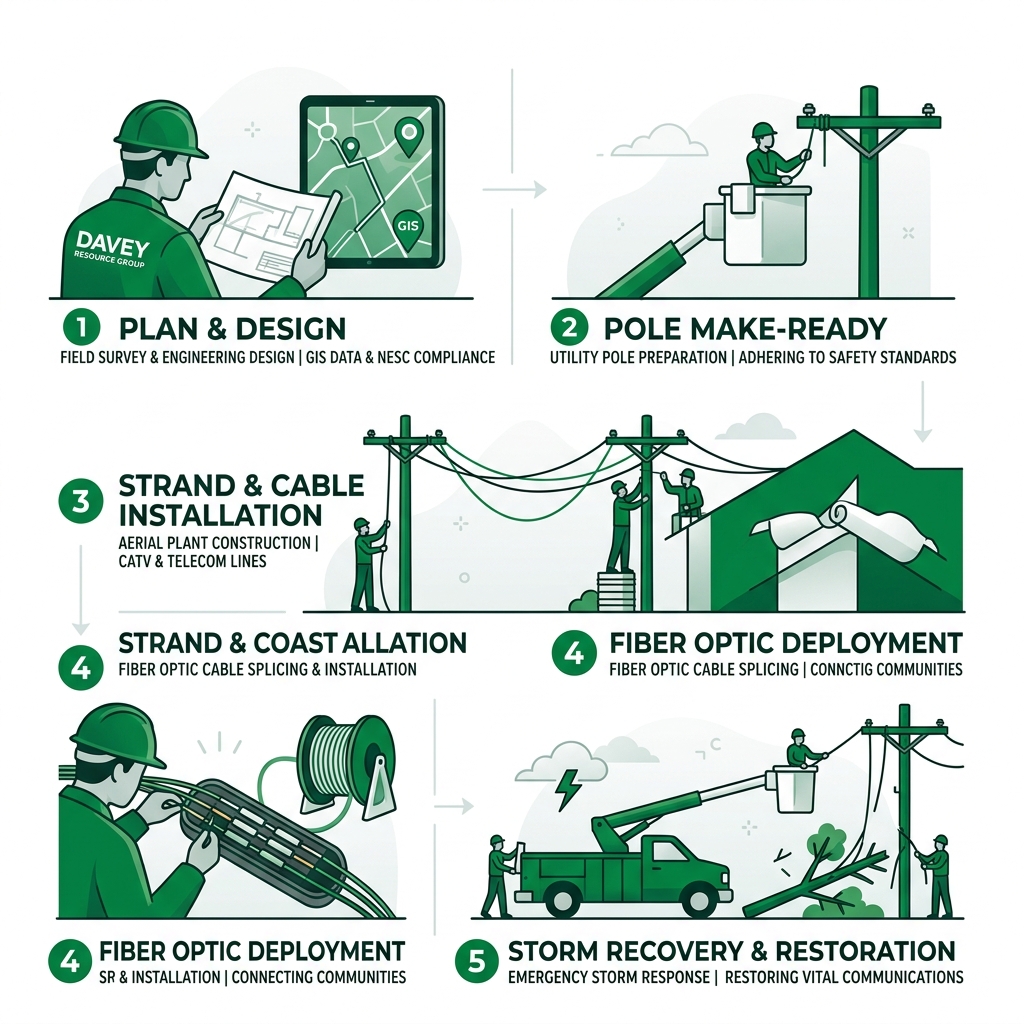
Lifecycle of communications line construction from design to fiber deployment to storm recovery infographic

Core Services of a Utility Telecommunications Lineman

When we talk about the utility telecommunications lineman, we are looking at a professional who sits at the intersection of heavy construction and high-tech communication. At Sylvan Scapes, we often see these teams in action while we are managing the vegetation around utility lines in the Shenandoah Valley. Their scope of work is vast, covering everything from the initial installation of macro-sites to the fine-tuning of small cell technology.

The primary mission of utility asset management is to provide end-to-end solutions for the telecommunications and electrical industries. This includes fiber upgrades that bring high-speed internet to rural areas and the complex task of copper wire removal. In many cases, after a fiber upgrade is completed, the utility lineman will remove old copper drop wires from homes and businesses. This doesn’t just save the client money; it reduces the physical load on the utility poles, extending the life of the infrastructure.

Comprehensive Project Management

A major differentiator for top-tier utility firms is their ability to handle project management from the initial design phase through to full implementation. They don’t just show up and climb; they are part of a strategic team that maintains relationships with major carriers to streamline upgrades. This includes traditional macro-site construction as well as modern CRAN and In-building tower solutions.

Infrastructure Reliability and Maintenance

Reliability is the name of the game. A utility lineman or technician often performs massive pole audits to ensure the grid can handle new attachments. For example, specialized teams have collected data on over 13,000 utility poles for joint-use audits to support broadband installation. They also use GIS (Geographic Information System) inventory to map out infrastructure with incredible precision, having surveyed over 11 million feet of lines for fiber route design. These utility infrastructure reliability services are what prevent the “surprise” outages that frustrate homeowners and businesses alike.

Life on the Line: Responsibilities and Daily Operations

What does a typical Tuesday look like for a utility telecommunications lineman? It usually starts early and involves a lot of windshield time. Because utility services cover such a wide area, travel is a core part of the job description. In many roles, there is a 75% to 100% travel expectation. For those working in asset management, this might mean being away from home during the week and returning on weekends, with the company providing lodging and a vehicle.

Daily Tasks for a Utility Telecommunications Lineman

The “office” for these professionals is often a bucket truck or the side of a utility pole at 20+ feet in the air. Daily responsibilities include:

  • Installing and maintaining CATV lines: This involves working with strand, coax, and fiber optic cables.
  • Troubleshooting: Using tools like voltmeters and signal level meters to find and fix connectivity issues.
  • Site Restoration: Ensuring that once the work is done, the area is clean and safe for the public.
  • Landowner Interaction: Professionally communicating with property owners to explain what work is being done on their land.

Travel and Field Logistics

Utility service providers take care of their field crews. For roles requiring heavy travel, companies typically provide a company vehicle, a gas card, and cover lodging costs. Additionally, linemen often receive a $35/day meal per diem. The work week is usually a minimum of 40-45 hours, but during storm recovery or major rollouts, those hours can certainly climb.

Safety First: Protocols for High-Risk Utility Work

Safety isn’t just a manual in this industry; it’s a culture. When you’re working around high-voltage lines and climbing poles, there is zero room for error. We follow similar strict protocols at Sylvan Scapes when we are performing technical tree removals near power lines, so we have a deep respect for the industry’s rigorous safety standards.

The utility telecommunications lineman must be an expert in the National Electrical Safety Code (NESC). They are trained to identify NESC violations on existing poles that could lead to fires or outages. Before even touching a pole, they perform “foreign voltage” testing to ensure the structure isn’t energized by a fault.

Advanced Diagnostic Technology

Leading utility firms use cutting-edge tech to stay safe and efficient:

  • Infrared Detection: Using FLIR T-640 cameras to find “hot spots” in equipment before they fail.
  • Radiofrequency Technology: Identifying problematic circuits using patented RFI technology.
  • Resistograph Testing: Using a specialized drill to measure the internal integrity of wood poles.

Rigorous Field Training

New hires don’t just jump into a bucket. They undergo extensive training in climbing gear safety, gaffing techniques, and power tool proficiency. OSHA certification is often a requirement or a highly preferred qualification. Mastering these safety standards early on is essential for long-term career growth in the utility sector.

Career Path: Qualifications and Growth for a Utility Telecommunications Lineman

Becoming a utility telecommunications lineman requires a blend of physical stamina and technical aptitude. This isn’t a desk job. You need to be able to lift 75-80 lbs regularly and be comfortable working at heights.

Key Qualifications:

  • Experience: Most Telecommunications Lineman roles prefer at least 2 years of aerial experience.
  • CDL Class A: Having a commercial driver’s license often bumps your pay grade significantly (up to the $30/hr range).
  • DOT Medical Card: You must be able to pass a physical and drug screen.
  • Education: A high school diploma or GED is the standard baseline.

Compensation and Benefits Package

Utility contractors offer competitive pay that reflects the difficulty of the work.

  • Hourly Rates: Generally range from $20 to $30 per hour depending on location and experience.
  • 401(k): Many companies offer a match of up to 4%.
  • Employee Stock Purchase Plan: Some firms offer discounts on company stock, which is a significant perk in employee-owned models.
  • Health Insurance: Comprehensive dental, vision, and medical plans.

Professional Development

This industry is known for promoting from within. A ground-level pole technician can work their way up to a Lineman 1, then a crew lead, and eventually into project management or development. The utility asset management sector is constantly expanding, providing a stable environment for long-term career building.

Real-World Impact: Case Studies in Infrastructure Reliability

The work of a utility telecommunications lineman has a tangible impact on the community. Here are a few examples of this expertise in action:

  • Tornado Recovery: After devastating tornadoes in Hamilton County, specialized utility teams were on the ground immediately, restoring connectivity to 86 critical areas.
  • Broadband Expansion: In the Midwest, crews completed a massive fiber expansion project, clearing vegetation and installing miles of overhead line on a tight schedule.
  • Hazard Mitigation: Across multiple states, teams identified and removed hazardous “two-pole” conditions (where a new pole is installed but the old one remains attached), significantly improving public safety.
  • Massive Data Collection: By auditing 13,000 poles and surveying 11 million feet of line, they provided the blueprint for modern fiber-to-the-home projects.

Why the Employee-Owned Model Matters in Utility Services

One of the most unique aspects of being a utility telecommunications lineman is that you often aren’t just an employee; you are an owner. Many major utility service providers have been employee-owned for decades, making them some of the largest such companies in the United States.

This model changes the “vibe” on the job site. When the workers own the company, there is a higher level of accountability and an entrepreneurial spirit. It means the person climbing the pole has a direct stake in the company’s safety record and profitability. For the lineman, this translates to long-term stability and a retirement nest egg through employee stock purchase plans and 401(k) matches.

Frequently Asked Questions about Utility Linemen

What is the starting pay for a utility telecommunications lineman?

Starting pay typically ranges from $20 to $25 per hour for those with basic experience. However, if you have a CDL Class A, pay often starts between $25 and $30 per hour.

Do utility companies provide the vehicle and tools for travel-heavy roles?

Yes. For roles requiring significant travel, companies typically provide a company vehicle, a gas card, and cover all lodging expenses. They also provide specialized tools like signal meters and climbing gear, though some linemen prefer to use their own hand tools.

What certifications are most important for new applicants?

An OSHA 10 or 30-hour construction safety certification is highly valued. Additionally, a CDL Class A is one of the most important certifications for increasing your earning potential and responsibilities.

Conclusion

The role of a utility telecommunications lineman is vital to the modern world. Whether they are restoring power after a storm or hanging the fiber that allows a small business to thrive, their work is the backbone of our infrastructure. At Sylvan Scapes, we share that commitment to excellence and safety in everything we do—from tree preservation to commercial grounds maintenance in the Shenandoah Valley.

If you are a business owner or property manager looking for the same level of professional care for your landscape that specialized utility teams bring to the grid, we are here to help. Contact Sylvan Scapes for Commercial Grounds Maintenance today, and let our ISA Certified Arborists ensure your property is safe, beautiful, and built to last.

You Don’t Need a Big Budget — or a Big Yard — to Get a Beautiful Landscape

Simple landscape design images are one of the fastest ways to go from “I don’t know where to start” to a clear plan for your outdoor space.

Here are the most common simple landscape styles worth exploring:

Style Key Feature Best For
Minimalist gravel courtyard Pea gravel + stone pavers Low-maintenance front yards
Defined garden beds Metal edging + repeated plantings Curb appeal on a budget
Vertical backyard Pergola + climbing plants Small or narrow spaces
Woodland no-lawn Native shrubs + mulch paths Shaded or sloped yards
Raised bed garden Untreated lumber + organic soil Edible or tidy kitchen gardens

Most people spend too much time picking plants and not enough time thinking about layout. The strongest designs start with structure — paths, edges, outdoor zones — and let the plants fill in from there.

That principle holds whether you have a quarter-acre in Staunton or a compact backyard in Waynesboro.

I’m Kevin Thompson, founder of Sylvan Scapes and an ISA Certified Arborist with over two decades of hands-on landscaping experience across the Shenandoah Valley — and simple landscape design images are something I reference constantly when walking properties with clients to help them see what’s possible before a single shovel hits the ground. Read on for the ideas that actually work in our Virginia climate.

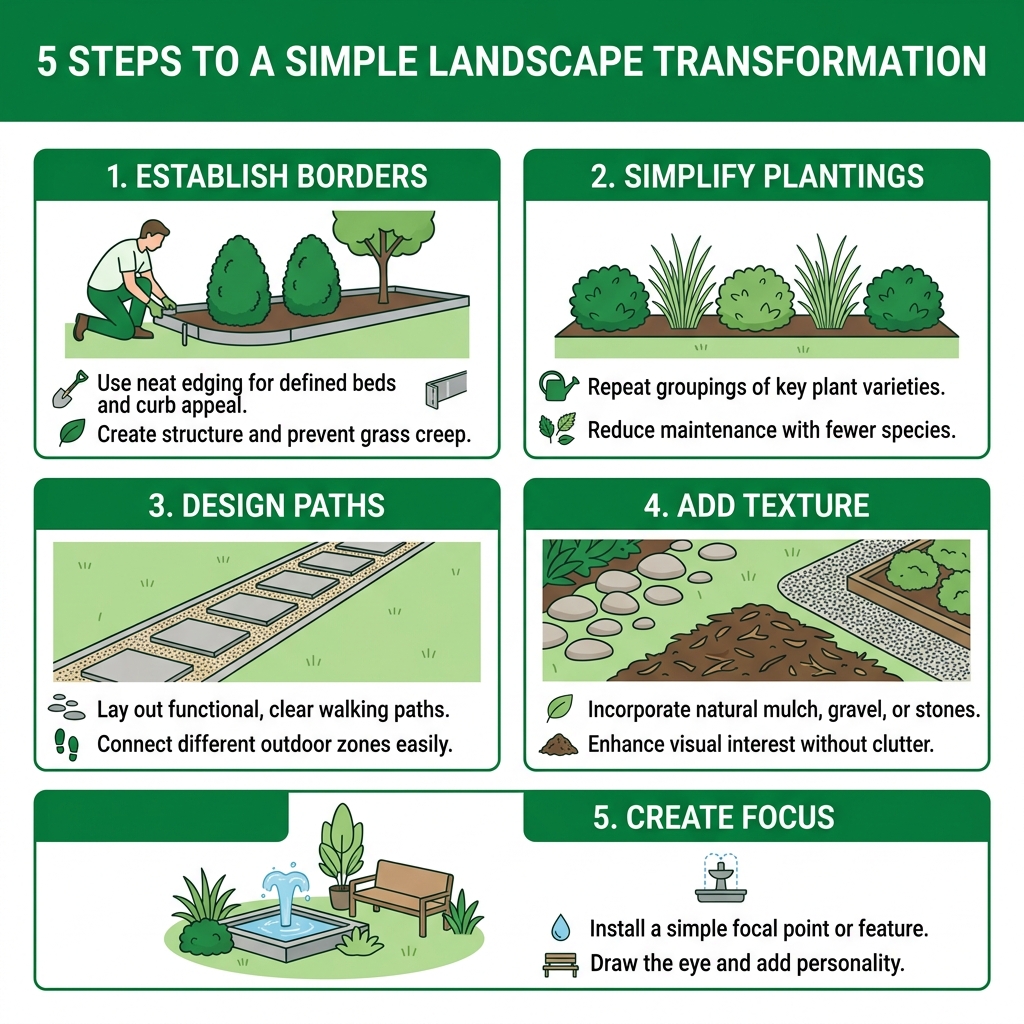
5 steps to a simple landscape transformation infographic - simple landscape design images infographic

Core Principles of Simple Landscape Design Images

When we look at simple landscape design images, the most successful ones share a common thread: they don’t try to do too much. In professional landscaping, we call this “restraint.” It is the difference between a yard that feels like a chaotic collection of plants and one that feels like a cohesive retreat.

Minimalism and Functionality

The core of a simple design is minimalism. This doesn’t mean your yard has to look like a barren desert. Instead, it means every element has a purpose. We often encourage homeowners to start by identifying their top priorities. Do you need a spot for the kids to play, or are you dreaming of a quiet corner for morning coffee? By focusing on functionality first, we can create a layout that serves your life rather than just your eyes.

The Power of Negative Space

One of the biggest mistakes we see in DIY projects is the “filling the void” trap. People see an empty patch of grass and feel compelled to put a shrub in it. In professional Residential Category designs, we use negative space—like a clean sweep of lawn or a tidy gravel courtyard—to give the eye a place to rest. This makes the features you do include, like a beautiful specimen tree or a stone walkway, stand out even more.

Sustainable Practices and Planning

Sustainability isn’t just a buzzword; it’s a way to keep your maintenance hours low. We often look at a Case study of a simple sustainable garden to show how mapping out sun patterns and water runoff before you plant can save you thousands of dollars in the long run. In the Shenandoah Valley, we have to account for our specific soil types and seasonal changes. A simple, sustainable garden uses plants that actually want to be here, rather than fighting against the local environment.

clean garden layout with defined edges - simple landscape design images

Low-Maintenance Hardscapes and Permeable Materials

Hardscaping is the “skeleton” of your yard. If you get the hardscape right, the rest of the design falls into place. When browsing simple landscape design images, you’ll notice that many modern, professional-looking yards have replaced large, thirsty lawns with permeable materials.

Why Permeable Surfaces Matter

Permeable materials like pea gravel, decomposed granite, and sand-set pavers allow rainwater to soak back into the ground rather than running off into the street. This is crucial because urban and suburban areas can be up to 90% more flood-prone than natural land due to non-porous surfaces like concrete.

We often point clients toward our Portfolio Entries Hardscapes to show how a gravel patio can look just as high-end as poured concrete but with better drainage and a much lower price tag.

Comparing Your Options

If you’re deciding between a traditional slab and a more modern permeable approach, consider this comparison:

Feature Poured Concrete Permeable Pea Gravel
Installation Cost High (requires forms & pro labor) Low to Moderate
DIY Friendliness Low High
Drainage Poor (runoff issues) Excellent
Maintenance Crack repair & sealing Occasional raking/weeding
Visual Style Industrial/Solid Textural/Natural

The Secret to Professional Edges

The difference between a “home-made” look and a professional finish often comes down to the edging. We highly recommend metal edging over plastic. Metal provides a slim, nearly invisible line that keeps gravel in its place and creates those crisp, clean curves you see in high-end simple landscape design images. It doesn’t heave out of the ground during our Virginia winters like plastic does, and it gives your garden beds a permanent, structured look.

Smart Plant Selection for the Shenandoah Valley

Choosing the right plants is where many homeowners get overwhelmed. With thousands of options at the nursery, it’s easy to end up with one of everything. To achieve a professional look, we follow the “Rule of Repetition.”

The Power of Plant Repetition

Instead of buying twenty different plants, buy five varieties and plant them in groups. This creates a sense of rhythm and harmony. When you look at our Staunton Landscaping Ideas Gallery, you’ll see that we often use the same ornamental grass or perennial flower in multiple spots throughout the yard. This ties the whole design together and, as a bonus, makes maintenance much easier because you only have to learn the care needs of a few species.

Climate-Appropriate Choices

In Albemarle and Augusta counties, we need plants that can handle humid summers and chilly winters. We often recommend “no-fuss” varieties that offer year-round interest. For example, the Great Plant Picks: Japanese Cedar (Cryptomeria) is a fantastic evergreen that provides structure and privacy without requiring constant pruning.

Using Specimen Plants in Simple Landscape Design Images

A “specimen” plant is the star of the show. In a simple design, you might have a sea of low-maintenance groundcover with one spectacular specimen plant as the focal point.

  • Japanese Maples: Varieties like ‘Crimson Queen’ or ‘Butterfly’ offer stunning leaf shapes and colors. They grow slowly, meaning they won’t outgrow their space in a few years.
  • Heuchera (Coral Bells): These are the “secret weapon” of simple designs. They come in colors ranging from lime green to deep purple. We’ve found that darker varieties, like ‘Caramel’, can actually handle quite a bit of sun in our region, despite being known as shade plants.
  • The Odd Number Rule: Always plant in odd numbers—threes, fives, or sevens. For some reason, the human brain finds odd groupings more natural and less “stiff” than even numbers.

Maximizing Small Spaces with Layout and Verticality

Don’t let a small backyard in Rockingham County discourage you. Small spaces are actually some of the most rewarding to design because every square inch counts.

Creating Outdoor Rooms

Think of your yard as an extension of your home’s floor plan. You can use outdoor rugs, groupings of pots, or even a simple change in ground material (like moving from grass to gravel) to define “rooms.” A pergola is a fantastic way to create a ceiling for your outdoor room, making the space feel cozy and organized. You can see examples of these structures in our Portfolio Entries Arbor section.

Thinking Vertically

When you run out of horizontal space, go up! Vertical gardening is a lifesaver for narrow side yards or small patios.

  1. Treallises: Use them for climbing roses or clematis.
  2. Retaining Walls: These can double as built-in seating, saving you from having to crowd the yard with extra furniture.
  3. Hanging Elements: Adding plants to a second-story deck or fence can draw the eye upward, making a small yard feel much taller and more expansive.

Visual Tricks for Simple Landscape Design Images

Professional designers use several “tricks” to manipulate how large a space feels:

  • Sightlines: Keep the view from your back door clear to the furthest corner of the yard to maximize the sense of depth.
  • Arcs and Curves: Using a sweeping arc for a garden bed or walkway can make a rectangular yard feel more organic and spacious.
  • Landscape Lighting: Proper lighting is the ultimate space-expander. By illuminating trees or fences at the edge of your property, you extend the usable space into the evening hours. For some great visual examples, check out Houzz: Outdoor Lighting Inspiration.

Frequently Asked Questions about Simple Landscaping

How do I design a low-maintenance garden?

The key to low maintenance is “right plant, right place.” If you put a sun-loving plant in the shade, it will struggle and require more care. Also, minimize or eliminate the lawn. Lawns are the most high-maintenance part of any yard. Replacing grass with mulch, gravel, or native groundcovers will save you hours of mowing and fertilizing every week.

What are the best plants for small yards in Virginia?

We love using dwarf varieties. Look for “Dwarf” or “Nana” in the plant name. Dwarf blueberries, ‘Little Heath’ Pieris, and compact evergreens provide beauty without taking over the yard. Native Virginia plants like Heuchera, certain ferns, and Oakleaf Hydrangeas are also excellent because they are already adapted to our soil and pests.

How can I make my landscape look professional on a budget?

Focus on the edges and the mulch. A clean, weeded edge and a fresh layer of dark mulch can make even a simple garden look like it was professionally installed. Also, stick to a limited color palette. Using just two or three colors for your flowers and foliage creates a sophisticated, high-end look that “busy” gardens often lack.

Conclusion

Transforming your yard doesn’t have to be an overwhelming project. By focusing on the core principles of layout, choosing a limited palette of hardy plants, and utilizing smart hardscape materials, you can create a space that is both beautiful and easy to manage.

At Sylvan Scapes, we’ve been helping homeowners across the Shenandoah Valley—from Staunton to Charlottesville—achieve their outdoor dreams since 2003. Whether you need an ISA Certified Arborist to evaluate the health of your trees or a Staunton Hardscape Company to install a new permeable patio, we have the expertise to make it happen.

Stop dreaming about those simple landscape design images and start digging. Your perfect outdoor retreat is closer than you think. Contact us today to see how we can bring professional structure and beauty to your home.

Selecting Grass Types and Timing for Staunton

Turf sod installation Staunton is one of the fastest ways to go from a patchy, bare yard to a thick, green lawn — often in a single day.

Here’s a quick overview of what successful sod installation in Staunton involves:

Step What to Do
1. Choose your grass Tall Fescue or Zoysia for Staunton’s transition zone climate
2. Time it right Install cool-season sod in Sept–Oct or April–May
3. Prep the soil Test pH, till 3–4 inches, remove rocks, grade for drainage
4. Lay the sod Stagger seams like brickwork, roll for soil contact
5. Water immediately 1 inch per day for the first two weeks
6. Budget correctly Expect $376–$736 average installed cost in Staunton

Staunton is home to roughly 25,000 residents nestled in the Shenandoah Valley — a region where a well-kept lawn isn’t just nice to have, it’s part of the landscape’s identity. Whether you’re dealing with a bare new-construction lot, a lawn that lost the battle to weeds, or simply want to boost curb appeal fast, sod gives you instant results that seeding simply can’t match.

But getting it right takes more than rolling out grass and hoping for rain. Soil prep, timing, grass variety, and proper watering all determine whether your new lawn thrives or struggles within its first season.

I’m Kevin Thompson, founder of Sylvan Scapes and an ISA Certified Arborist who has been working the soil of Augusta County since 2003 — including overseeing turf sod installation Staunton projects for residential and commercial clients across the Shenandoah Valley. In this guide, I’ll walk you through everything you need to know to get a beautiful, lasting lawn without the guesswork.

Staunton sits in what we call a “transition zone.” This means our humid subtropical climate features hot, sticky summers and winters that can get quite chilly. Because we are caught between the North and the South, choosing the right grass is the most critical decision you’ll make. If you pick a grass that can’t handle a Shenandoah Valley August or a January freeze, your investment literally goes out the window.

When we look at Staunton Landscaping Ideas Gallery, we see a mix of textures and colors, but the foundation is always the turf. In our region, you essentially have two paths: cool-season grasses or warm-season varieties.

Cool-Season vs. Warm-Season Varieties

Tall Fescue: This is the “Old Reliable” of Staunton. It stays green for most of the year and handles our clay-heavy soil better than most. It has a deep root system that helps it survive summer dry spells, though it might need a little extra drink when the Valley heat peaks in July.

Kentucky Bluegrass: Known for its stunning deep blue-green color and soft texture, Bluegrass is a favorite for high-end residential lawns. However, it can be a bit more “needy” than Fescue, requiring more water and maintenance to keep it looking like a golf course.

Bermuda and Zoysia: These are warm-season grasses. They love the heat and are incredibly durable. If you have kids or dogs running around, these are tough to beat. The trade-down? They go dormant and turn a tan/brown color as soon as the first hard frost hits Staunton, usually staying that way until late spring.

The Best Months for Installation

Timing is everything. You wouldn’t wear a parka in July, and you shouldn’t lay cool-season sod in the middle of a heatwave.

For Tall Fescue and Kentucky Bluegrass, September and October are the “Golden Months.” The soil is still warm from summer, but the air is cooling down, which encourages rapid root growth without the stress of extreme heat. April and May are your second-best windows.

For warm-season grasses like Zoysia or Bermuda, you want to install them in late spring or early summer so they can establish themselves during their peak growing season. We generally advise against installing sod in November; with average Staunton lows hitting 32°F, the grass often can’t “knit” into the soil before the ground freezes. For long-term success, check out our guide on Staunton Landscaping Company Turf Maintenance to see how seasonal timing affects your lawn’s health.

The Step-by-Step Process for Turf Sod Installation Staunton

Getting a “magazine-ready” lawn isn’t just about the grass; it’s about the dirt underneath. We often tell clients that 90% of a successful turf sod installation Staunton happens before the first piece of grass even touches the ground.

Preparing Your Soil for Turf Sod Installation Staunton

First, we have to clear the canvas. This means removing every bit of existing weed, old grass, and debris. We’ve seen projects where people try to lay sod over old weeds—don’t do it! The weeds will just grow through the seams.

  1. Soil Testing & pH Adjustment: Most soil in the Shenandoah Valley is naturally acidic. We recommend a soil test to see exactly what nutrients are missing. Often, we need a lime application to balance the pH, which ensures the grass can actually “eat” the fertilizer you give it.
  2. Core Aeration & Rototilling: If your soil is hard as a rock (common in our clay-rich area), the roots won’t be able to penetrate. We rototill the top 3–4 inches to loosen things up. If you’re looking for inspiration on how we’ve transformed local yards, browse our Portfolio Entries Turf.
  3. Grading: This is where we prevent future headaches. We smooth the area with a metal rake and ensure the ground slopes away from your home’s foundation. This prevents “puddling” and drainage issues that can rot your new sod’s roots.

Laying and Finishing the Sod

Once the soil is prepped and lightly dampened, it’s time for the “instant” part of the transformation. We source high-quality, non-netted sod from local farms to ensure it’s harvested fresh—usually within 24 hours of being laid.

  • The Straight Edge Start: We always start along a straight edge, like a driveway or a sidewalk.
  • The Brick Pattern: Just like a brick wall, we stagger the seams. This prevents long, straight lines where water could wash away soil or where the sod might pull apart.
  • Tight Joints: We push the edges of the sod together firmly but never overlap them. Overlapping creates bumps; gaps create weed havens.
  • Rolling: After the sod is down, we use a water-filled roller to press the grass into the soil. This eliminates air pockets—the number one killer of new sod. If the roots aren’t touching the dirt, they can’t grow.

Budgeting: Costs and Professional vs. DIY Factors

Let’s talk numbers. While sod is more expensive than seed, the “instant” value and the fact that you aren’t fighting birds and washouts for six months makes it a smart investment for many Staunton homeowners.

On average, a professional turf sod installation Staunton ranges from $376 to $736 for smaller projects, but the price scales based on your yard’s size and the grass type you choose.

Area Size Grass Type Estimated Cost (Staunton)
500 sq ft Bermuda $335 – $435
500 sq ft Kentucky Bluegrass $185 – $360
500 sq ft Zoysia $285 – $460
2000 sq ft Tall Fescue $1,210 – $1,710
2000 sq ft Bermuda $1,310 – $1,710

Additional factors that can impact your quote include:

  • Regrading: ~$0.55 per sq ft
  • Topsoil Addition: ~$0.25 per sq ft
  • Sod Removal (Old Grass): ~$0.45 per sq ft

For businesses, we provide specialized pricing through our Staunton Commercial Landscaping Company Turf Maintenance services, which often involve larger-scale “Big Roll” installations.

Evaluating DIY vs. Professional Turf Sod Installation Staunton

Can you do this yourself? Absolutely. But it is back-breaking work. A single pallet of sod can weigh between 1,500 and 3,000 pounds depending on moisture. If you’re doing a 2,000 sq ft yard, you’re moving four pallets of weight by hand.

DIY Pros: You save on labor costs. You can get a pallet from a sod farm for as low as $160. DIY Cons: You have to rent equipment (tillers, rollers), arrange delivery or have a heavy-duty truck, and you don’t get a warranty. If the sod dies because of a mistake in prep, you’re out of luck.

Hiring a professional team like ours means we handle the heavy lifting, the specialized tools, and the precision grading. We also bring the expertise of an ISA Certified Arborist to ensure the turf integrates perfectly with your existing trees and landscape. You can learn more about the Benefits of Professional Lawn Care Services to see how we beat the “DIY stress.”

Post-Installation Care and Maintenance

Congratulations, you have a green lawn! Now, don’t let it die. The first 14 days are the most critical period in the life of your turf.

Watering and Mowing Guidelines

Watering: You need to water immediately—within 15 minutes of the first roll being laid. For the first two weeks, your goal is to keep the sod and the soil underneath soaking wet. We recommend 1 inch of water per day, which usually means running a sprinkler for about 30 minutes in each spot, twice a day (morning and late afternoon). After two weeks, you can taper off to every other day, and eventually to twice a week.

Mowing: Resist the urge to mow too soon! Wait until the grass is about 3–4 inches tall and, most importantly, make sure it has “knitted” to the ground. If you can tug on the grass and the whole piece lifts up, it’s not ready. When you do mow, use a sharp blade and never take off more than one-third of the grass height at once.

Long-Term Health and Fertilization

To keep that Staunton green vibrant, you’ll need a consistent plan:

  • Starter Fertilizer: We apply this at half-rate during installation to give the roots a boost.
  • Grub Prevention: In late May or June, we recommend a preventative treatment to stop pests from eating your new roots.
  • Weed Control: Once established, a seasonal program will keep invasive species like wiregrass from moving in.
  • Seasonal Clean-ups: Keeping leaves off your new sod in the fall is vital so the grass doesn’t “smother” and die over the winter.

Frequently Asked Questions about Staunton Sod

How much does a pallet of sod cover in Staunton?

Most pallets in our region cover 500 square feet, though some farms use 400 or 450 sq ft pallets. Always verify the square footage with your supplier before ordering!

What is the average cost of sod installation in Staunton?

For a standard residential project, expect to pay between $376 and $736 for basic areas. For a full yard (around 2,000 sq ft), the cost typically ranges from $1,200 to $1,800 depending on the grass variety and the amount of site preparation needed.

Can I install sod in the winter in Virginia?

Technically, you can lay sod as long as the ground isn’t frozen, but we don’t recommend it. In Staunton, November through February is risky because the grass goes dormant and won’t grow the roots it needs to survive the drying winter winds. It’s better to wait for the spring thaw.

Conclusion

A beautiful lawn is an investment in your home’s value and your own peace of mind. At Sylvan Scapes, we’ve spent two decades perfecting the art of turf sod installation Staunton. From the initial soil test to the final roll of the drum, we treat your yard like it’s our own.

As a CTSP-certified company with an ISA Certified Arborist on staff, we don’t just “lay grass”—we build sustainable, healthy outdoor environments that thrive in the unique climate of the Shenandoah Valley. Whether you are in Staunton, Charlottesville, or anywhere in Augusta County, we are here to help you get that dream lawn without breaking a sweat.

Ready to transform your yard? Get a Staunton Landscaping Company Free Estimate today and let us handle the heavy lifting!

Understanding Local Snow Removal Responsibilities

In Albemarle County, knowing who to call depends entirely on where the snow is sitting. The responsibility for albemarle winter snow services is a shared partnership between state agencies, local government, and private property owners.

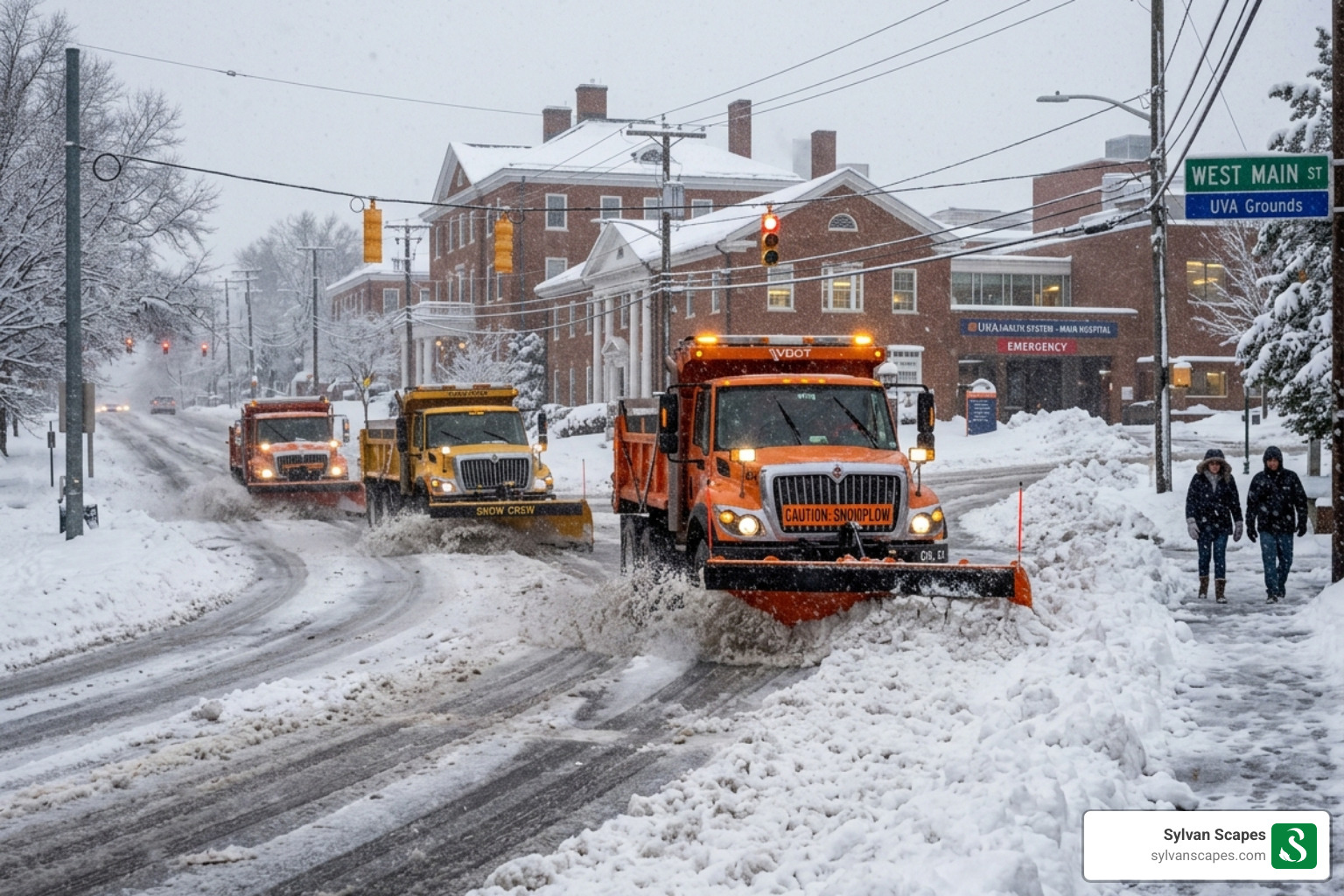
The Virginia Department of Transportation (VDOT) is the primary authority for public roads. They manage snow and ice removal for interstates, primary roads, and secondary public roads. VDOT operates on a priority system, focusing first on high-volume corridors like Route 29, Route 250, and I-64 to ensure emergency vehicles and transit can move. You can track their progress or report issues at 1-800-FOR-ROAD.

However, VDOT does not clear private streets. If your street doesn’t have a state route number, it’s likely a private road. In these cases, the responsibility falls to:

  • Homeowner Associations (HOAs): Most modern subdivisions have covenants requiring the HOA to contract for snow removal.
  • Property Management Companies: For apartment complexes and commercial centers.
  • Developers: If a subdivision is still under construction and the roads haven’t been “accepted” into the state system, the builder is usually on the hook.

Albemarle County government itself has a very specific lane. The Snow Removal | Albemarle County, VA page clarifies that the County Facilities & Environmental Services (FES) only clears properties the county actually owns—think schools, libraries, and fire stations.

The City of Charlottesville operates under a different set of rules. While the city clears public streets and the Downtown Pedestrian Mall, property owners are legally required to clear the sidewalks adjacent to their land. To see exactly where city lines and public rights-of-way fall, you can consult the GIS Data for Charlottesville.

Municipal Requirements for albemarle winter snow services

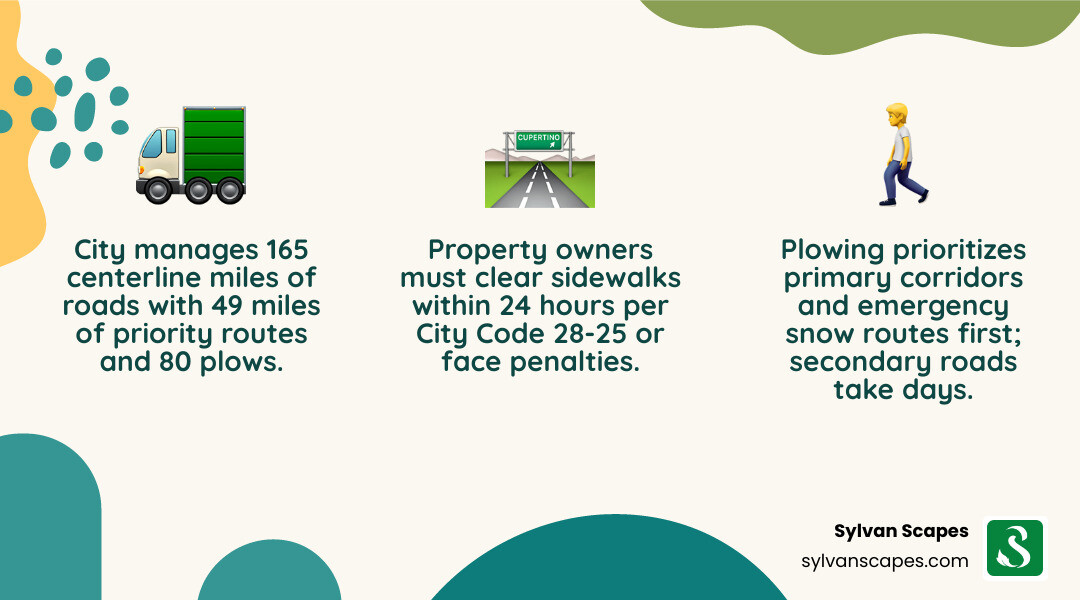
If your business or home is within the Charlottesville city limits, “waiting for it to melt” isn’t a legal strategy. Under City Code Section 28-25, owners and occupants must clear snow, sleet, and ice from paved sidewalks fronting their property.

The “24-hour rule” is the standard here. Once the snowfall officially stops, the clock starts ticking. The City Manager’s office typically issues an official “stop of snow” announcement via local media and the city website. If you miss this window, the city may issue a warning. If the snow remains, the city can hire a private crew to clear it and send you the bill. You can find more details on these enforcement measures in the Frequently Asked Questions on Charlottesville Snow Removal.

Professional Standards for albemarle winter snow services

For commercial properties, “standard” service isn’t enough—you need reliability. Professional albemarle winter snow services are built on rapid response and 24/7 availability.

At Sylvan Scapes, we adhere to rigorous performance standards similar to those required by the County’s own contracts. For instance, critical Public Safety Facilities (like fire and rescue stations) often require contractors to be on-site within 30 minutes of notification. For non-public safety commercial sites, a 1-hour response window is the industry benchmark.

Most professional contracts are triggered by a specific accumulation level—usually 2 inches. However, we also monitor for “nuisance” events like freezing rain or black ice, which can be more dangerous than a foot of powder. Our Staunton Commercial Snow Removal team tracks storms in real-time to ensure we are mobilized before the morning commute.

Comprehensive Commercial Snow and Ice Management

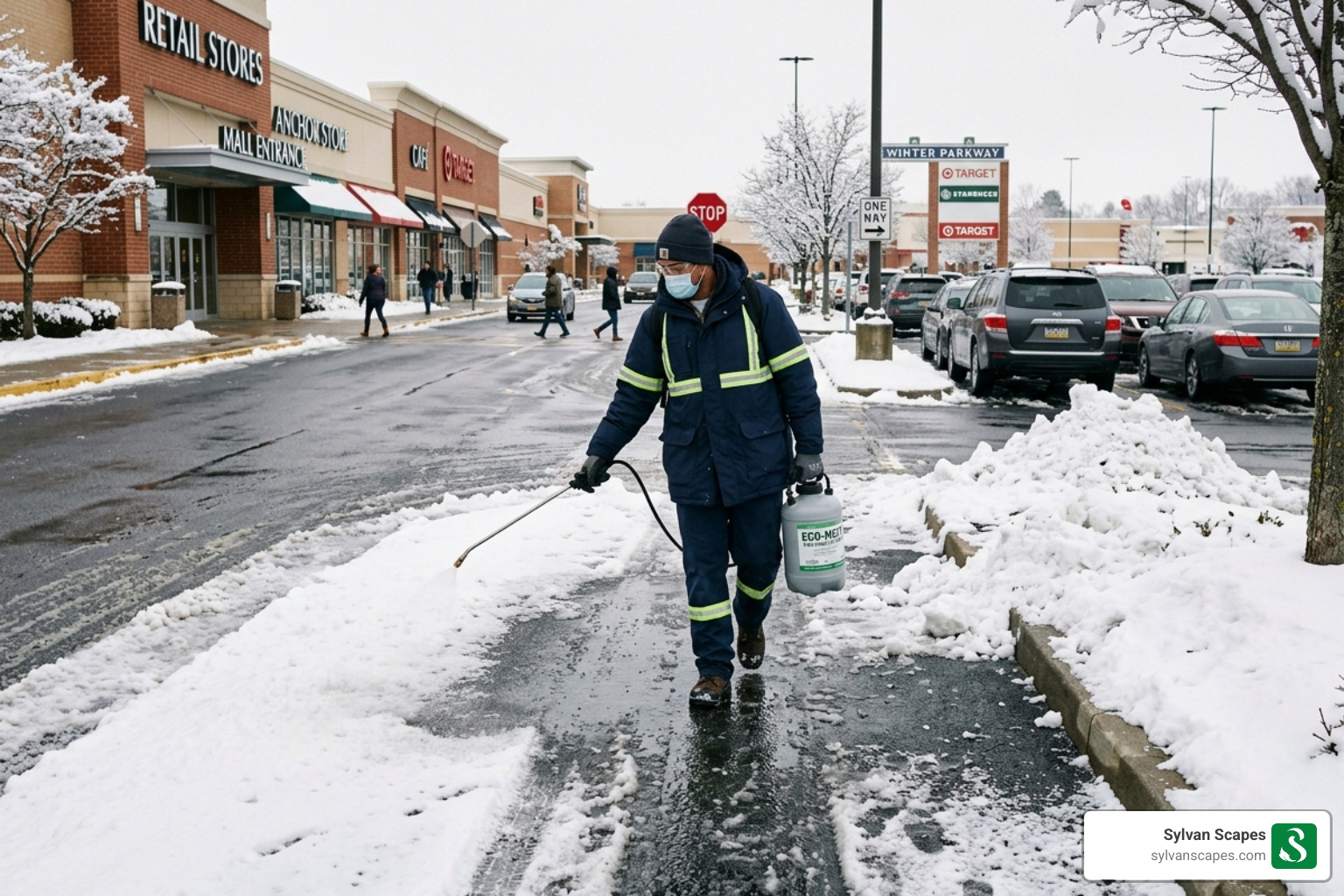
Eco-friendly liquid de-icer application on a commercial walkway - albemarle winter snow services

Managing a commercial property during a storm is about more than just a truck with a plow. It’s a multi-stage process designed to achieve “bare-pavement condition.” This means that after we finish, the asphalt or concrete is visible and safe for foot traffic and vehicles.

Our comprehensive approach includes:

  1. Snowplowing: Clearing parking lots and driveways, ensuring snow is piled in designated areas that won’t block sightlines or drain onto walkways when it melts.
  2. Shoveling: Hand-clearing entryways, stairs, and narrow sidewalks where heavy machinery can’t reach.
  3. Ice Management: Applying treatments to prevent the bond between ice and pavement.

The City of Charlottesville Winter Storm Operations often highlights the importance of 24/7 operations during significant events. For businesses, this prevents “refreezing”—a common hazard where melted snow turns into a sheet of ice overnight. By using a combination of liquid de-icers, granular melts, and sand for traction, we mitigate property damage and significantly reduce slip-and-fall liability.

Advanced De-icing and Anti-icing Techniques

We’ve moved far beyond just throwing rock salt at the ground. Modern albemarle winter snow services utilize science-based applications:

  • Brine Pretreatment: Applying a liquid salt solution before the storm. This prevents snow from sticking and makes mechanical plowing much more effective.
  • Eco-Friendly Melts: We use magnesium chloride or complex chloride blends that are less corrosive to concrete and safer for the surrounding landscape.
  • Metal Staircase Safety: This is a big one. You should never use salt on metal stairs. The electrolytic reaction causes rapid corrosion and shortens the life of the structure. We use sand, cinders, or specialized non-corrosive pellets for these areas.
  • Real-time Monitoring: We constantly check Real-time road conditions via 511 Virginia to adjust our routes and application rates based on ground temperature and moisture levels.

Procurement and Planning for albemarle winter snow services

Facility manager reviewing a winter service contract for Albemarle County - albemarle winter snow services

The best time to hire a snow contractor was last August. The second best time is right now. Large entities in our region, like the County government, use formal “Term Contracts” to ensure they aren’t scrambling when a blizzard is forecast.

For example, the recent 2026-IFB-1010022 solicitation for snow removal and ice control services shows how detailed these requirements are. Bidders must prove they have the equipment, personnel, and insurance (often including $2M in general liability) to handle the job. You can view active opportunities and historical standards at the Albemarle County RFP Posts.

For private businesses, pre-season planning involves:

  • Site Familiarization: We walk your property in the fall to identify “hidden” hazards like speed bumps, curbs, and delicate landscaping that might be covered by snow.
  • Snow Piling Strategy: Deciding where the “snow graveyard” will be so it doesn’t block drains or create puddles that refreeze into ice patches.
  • OSHA Compliance: Ensuring all crews have the proper safety gear and training to operate in sub-zero, low-visibility conditions.

Winter Safety and Property Owner Guidelines

While professional crews handle the heavy lifting, residents and business owners play a vital role in community safety.

One of the most overlooked tasks is fire hydrant access. If there is a hydrant near your property, please clear a 3-foot radius around it. In an emergency, every second counts, and firefighters shouldn’t have to spend five minutes digging out a hydrant.

Other critical tips include:

  • Storm Drains: Keep them clear of snow and debris to prevent localized flooding when the thaw begins.
  • Deck Integrity: Heavy, wet snow can weigh thousands of pounds. If you have an older deck, consider safely shoveling it to prevent structural failure.
  • Stay Informed: Sign up for CUA 911 Emergency Notifications to get hyper-local updates on road closures and weather emergencies.
  • Power Safety: If the lights go out, never run a generator indoors. For outage updates, contact Dominion Energy Outage Reporting.

The Virginia Department of Emergency Management Preparedness guide is an excellent resource for building a home or office “winter kit,” including food, water, and layered clothing.

Frequently Asked Questions about Albemarle Snow Removal

Who is responsible for plowing my street in Albemarle County?

If it is a public road, VDOT is responsible. They prioritize primary routes first, then move to secondary roads and neighborhood streets. If it is a private street (common in many Crozet and Keswick subdivisions), the responsibility lies with your HOA or the developer if the neighborhood is still under a “bond.”

What are the response time expectations for commercial contractors?

Professional standards vary by facility type. Public safety sites usually require a 30-minute response. Most commercial retail and office contracts specify a 1-hour response time following notification or once snow reaches a 2-inch accumulation. At Sylvan Scapes, we operate 24/7 during storm events to ensure business continuity.

How can I minimize liability during a winter weather event?

The best defense is a proactive offense. This includes:

  • Pre-season inspections to fix drainage issues before they become ice patches.
  • Detailed record-keeping (we maintain logs of exactly when we plowed and what materials were applied).
  • Proactive de-icing to prevent slips before they happen.
  • Community awareness: If you know a neighbor is elderly or disabled, check on them or help clear their path. You can also direct those in need to Community support via 211 Virginia.

Conclusion

Winter in Albemarle County is beautiful, but it can be brutal for those unprepared. Whether you are managing a retail center in Pantops or a medical facility in Charlottesville, having a dedicated partner for albemarle winter snow services is the only way to ensure safety and minimize risk.

At Sylvan Scapes, we bring the same precision to snow removal that we bring to our ISA Certified Arborist tree care and year-round grounds maintenance. We don’t just push snow; we manage your property’s winter risk from the first pretreatment to the final spring cleanup.

Don’t wait for the forecast to turn grey. Contact us today for a free proposal and let us keep your business moving, no matter what the Shenandoah Valley throws our way. Explore our Professional Commercial Snow Removal Services and secure your spot on our winter route today.

Why Choosing the Right Turf Lawn Care and Pest Control Service Matters

Professional turf lawn care and pest control covers a range of services – fertilization, weed control, pest management, and seasonal treatments – designed to keep your lawn healthy year-round. Here’s a quick breakdown of what to expect from a top-tier service:

Service What It Does How Often
Fertilization & Weed Control Feeds grass, kills unwanted plants Every 4-7 weeks
Pre & Post-Emergent Herbicides Stops and removes weeds at any stage Seasonally
Pest Control (mosquitoes, fire ants, grubs) Eliminates and prevents infestations Varies by pest
Core Aeration Improves nutrient and water uptake Spring or Fall
Tree & Shrub Care Protects and nourishes landscape plants Ongoing

Getting this right isn’t simple. Some weeds produce up to 100,000 seeds in a single life cycle, meaning one missed treatment can set your lawn back an entire season. And in climates like Virginia’s Shenandoah Valley – with clay-heavy soils and humid summers – a generic off-the-shelf approach rarely works.

That’s where professional, locally-tailored programs make a real difference.

I’m Kevin Thompson, ISA Certified Arborist and founder of Sylvan Scapes, and after two decades of hands-on grounds management and tree care across Augusta and Albemarle Counties, I’ve seen how the right professional turf lawn care and pest control program transforms a struggling property into one you’re proud of. Let’s dig into what separates the best services from the rest.

Benefits of year-round turf management including fertilization, pest control, aeration, and weed prevention - premium lawn care

The Science Behind Sylvan Scapes’ Premium Turf Lawn Care and Pest Control Results

Achieving a magazine-worthy lawn in Staunton or Charlottesville isn’t about luck; it is about chemistry and biology. At Sylvan Scapes, we believe that a beautiful lawn is an investment in your home’s legacy. To protect that investment, we look beneath the surface.

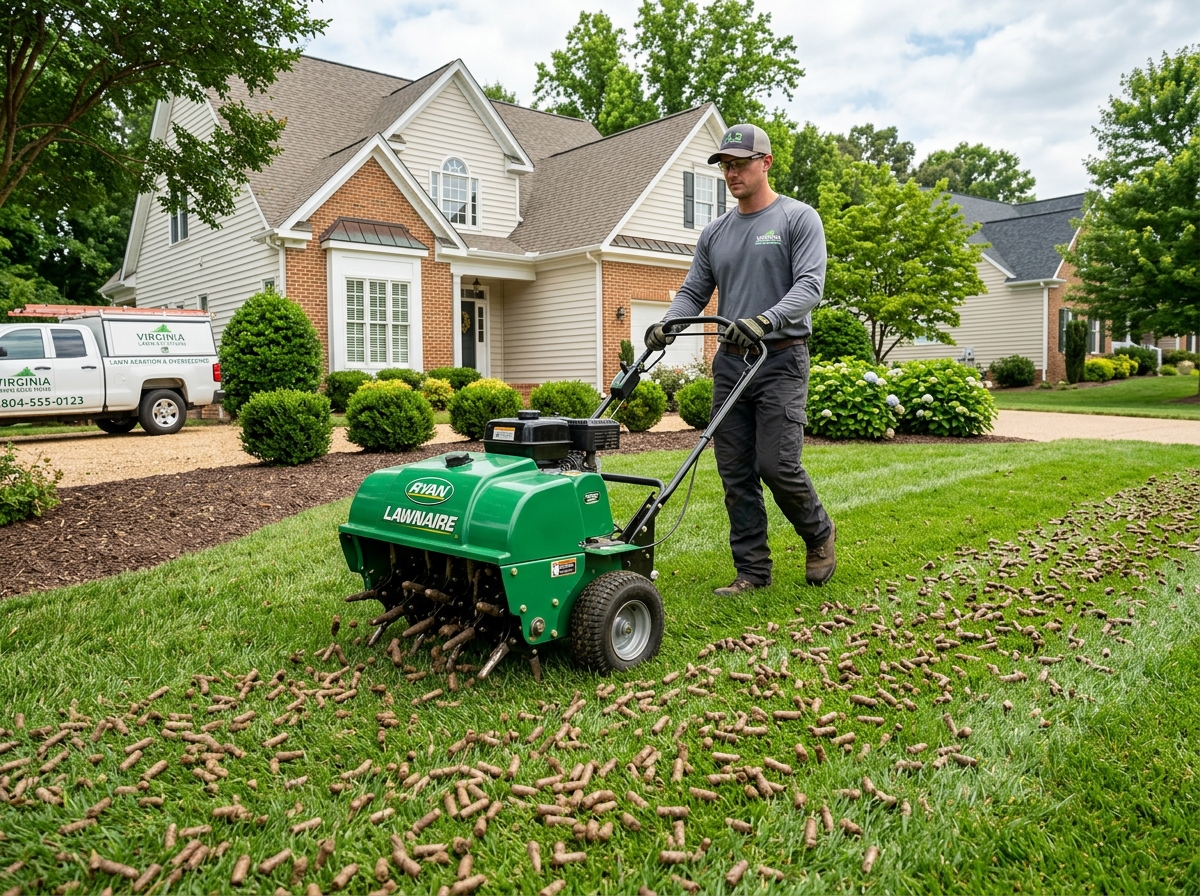
One of the biggest hurdles we face in the Shenandoah Valley is our soil. If you’ve ever tried to dig a hole in your backyard, you know we deal with heavy clay. This clay becomes compacted easily, suffocating grass roots and preventing water from reaching the root zone. This is why core aeration is a cornerstone of our program. By pulling small plugs of soil from the earth, we allow the “pores” of your lawn to breathe, encouraging deep root development that can withstand the stressors of a Virginia summer.

Furthermore, our regional soils are naturally acidic. When soil pH is off-balance, your grass literally cannot “eat” the nutrients you provide, no matter how much fertilizer you apply. We utilize lime applications to neutralize acidity, ensuring that every drop of nitrogen and phosphorus is put to work. This scientific approach to turf maintenance is what allows us to deliver results that store-bought bags simply can’t match.

Professional core aeration process showing soil plugs being removed to improve oxygen and nutrient flow - premium turf lawn care

Customizing Sylvan Scapes’ Professional Turf Lawn Care and Pest Control for Local Climates

The “one-size-fits-all” model of lawn care is a recipe for failure. A lawn in the humid subtropical climate of the Shenandoah Valley has very different needs than one in a cooler or more arid region. We tailor our programs to the specific grass types found in Albemarle and Augusta counties.

Whether you have a warm-season lawn like Bermuda or Zoysia, or a cool-season lawn featuring Tall Fescue, the timing of our applications is critical. For example, warm-season grasses need a “wake-up” boost in late spring, while Tall Fescue requires heavy lifting in the fall to recover from summer heat stress. Our customized approach ensures we are applying the right nutrients at the exact moment your specific grass type can use them.

Feature Warm-Season (Bermuda/Zoysia) Cool-Season (Tall Fescue)
Peak Growth Summer Spring & Fall
Best Aeration Time Late Spring / Early Summer Early Fall
Winter Behavior Goes Dormant (Brown) Stays Semi-Green
Drought Tolerance Very High Moderate

Integrated Pest Management for Sylvan Scapes’ Expert Turf Lawn Care and Pest Control

A healthy lawn isn’t just about green blades; it’s about a safe environment for your family and pets. Our comprehensive turf lawn care and pest control philosophy utilizes Integrated Pest Management (IPM). This means we don’t just spray chemicals indiscriminately; we target specific pests with precision.

  • Mosquitoes: We target breeding zones in dense foliage and shaded areas. Our barrier sprays operate on a 21-day cycle during the peak season to ensure your backyard remains a “go-zone” rather than a “no-go” zone.
  • Fire Ants: These painful pests can ruin a backyard barbecue. We offer specialized treatments that can provide protection for an entire year with a single, targeted application.
  • White Grubs: These larvae live in the soil and feast on grass roots, causing large patches of your lawn to die off suddenly. We apply preventative treatments in late May or June to stop them before they hatch.
  • Armyworms: These pests are notorious for eating every part of a grass blade, seemingly overnight. Our proactive monitoring allows us to catch infestations before they strip your lawn bare.
  • Moles and Voles: These tunneling critters create unsightly mounds and destroy root systems. We utilize specialized baits and tunnel management to move them along.

By combining these services, we create a comprehensive shield around your property. You can read our reviews to see how this integrated approach has helped neighbors throughout the valley reclaim their outdoor spaces.

Professional Services and Year-Round Maintenance

Consistency is the secret ingredient to a perfect lawn. Many homeowners make the mistake of only caring for their grass when it looks “bad.” By then, the damage is often done. Our premium turf lawn care and pest control programs operate on 4-7 week cycles throughout the year.

Why so frequent? Because weeds are relentless. As mentioned, a single weed can drop 100,000 seeds. If we aren’t there to apply pre-emergent barriers in the late winter and fall, those seeds will germinate the moment the temperature is right. Once weeds have taken root, we use systemic herbicides that target the weed’s vascular system, killing it down to the root without harming your desirable turfgrass.

Our year-round approach also includes specialized tree and shrub care. Your ornamental plants are the “bones” of your landscape, and they are often the most vulnerable to local diseases and pests like aphids or scale. We provide nutrient nourishment and disease protection to ensure your entire landscape – not just the grass – flourishes.

Advanced Strategies for Lawn Transformation

If your lawn is currently a “patchwork” of different colors and textures, it might need more than just a standard mow-and-blow service. We employ advanced strategies to renovate and elevate tired turf.

One of our most effective tools is the combination of core aeration and overseeding for cool-season lawns. In the Shenandoah Valley, summer heat can thin out Fescue. By aerating in the fall and seeding immediately after, we ensure the new seeds fall directly into the “pockets” created by the aerator, leading to much higher germination rates and a thicker, more resilient lawn.

We also focus on irrigation efficiency. Did you know that a properly calibrated irrigation system can produce water savings of over 50% compared to the traditional hose-and-sprinkler method? We help our clients optimize their watering schedules to promote deep root growth rather than shallow, weak roots that invite fungus.

Speaking of fungus, our humid Virginia summers are a breeding ground for lawn diseases like Brown Patch. Our programs include preventative fungicide applications from May through September to keep your lawn pristine even when the humidity is at its worst. For those struggling with invasive “wiregrass” (common Bermuda in a Fescue lawn), we offer specialized control programs that can achieve up to 85% effectiveness in the first year of treatment.

Frequently Asked Questions about Lawn Care

How often should my lawn be treated for weeds?

For the best results, your lawn should receive treatment every 4-7 weeks. This continual care allows us to adjust the “recipe” of our applications based on the current weather and the specific weeds that are germinating at that time of year. If a particularly stubborn weed pops up between our scheduled visits, we offer free service calls to handle the problem before it spreads.

Is professional pest control safe for my family?

Yes. We prioritize safety by using targeted applications and creating “outer barriers” around your home. Our mosquito sprays, for example, are applied to the foliage where mosquitoes rest, rather than being broadcast into the air. We recommend keeping pets and children off the lawn until the application is dry, after which it is safe to return to play.

What are the benefits of core aeration and seeding?

In our region, the primary benefit is thatch reduction and overcoming heavy clay soil. Thatch is a layer of dead organic matter that sits between the grass and the soil. If it gets thicker than half an inch, it blocks water and nutrients. Aeration breaks up this layer and the underlying clay, allowing for better nutrient penetration. Fall seeding then fills in any thin spots to prevent weeds from taking over in the spring.

Conclusion

At Sylvan Scapes, we don’t just see a lawn; we see an investment in your home’s beauty and your family’s comfort. As an ISA Certified Arborist-led company serving Staunton, Waynesboro, and the surrounding counties since 2003, we bring a level of expertise that goes beyond basic maintenance.

From tree preservation and pruning to comprehensive professional turf lawn care and pest control, we are dedicated to the health of the entire Shenandoah Valley landscape. Whether you are looking to transform a weed-choked yard into a verdant oasis or simply want to reclaim your weekends from the hassle of yard work, we are here to help.

Ready to see the difference that professional, arborist-backed care can make? Explore our professional turf maintenance and landscaping services and let’s start building the lawn of your dreams today.

What to Know Before Hiring Paver Patio Contractors

Paver patio contractors vary widely in skill, certification, and reliability — and choosing the wrong one can mean costly repairs down the road. Here’s a quick overview of what matters most:

How to find a reliable paver patio contractor:

  1. Check for ICPI certification — the Interlocking Concrete Pavement Institute sets the industry standard for proper installation
  2. Verify licensing and insurance — protects you if something goes wrong on your property
  3. Ask for a portfolio — look for clean edges, consistent patterns, and proper drainage in past projects
  4. Request a written warranty — reputable contractors offer labor warranties (commonly 3–5 years)
  5. Get multiple quotes — compare scope of work, not just price
  6. Read reviews — look for comments about timeliness, cleanup, and communication, not just the final result

A paver patio can completely transform how you use your outdoor space — whether that’s a quiet evening by a fire pit or hosting family on a summer weekend. But the finished product is only as good as the foundation beneath it. Poor installation leads to shifting, cracking, drainage problems, and expensive fixes. The right contractor gets it right the first time.

I’m Kevin Thompson, founder of Sylvan Scapes and a longtime advocate for quality craftsmanship in outdoor spaces — and through years of coordinating hardscape and grounds work across Augusta, Albemarle, and Rockingham Counties, I’ve seen what separates a trustworthy paver patio contractor from one that cuts corners. This guide will help you ask the right questions, spot the red flags, and make a confident decision.

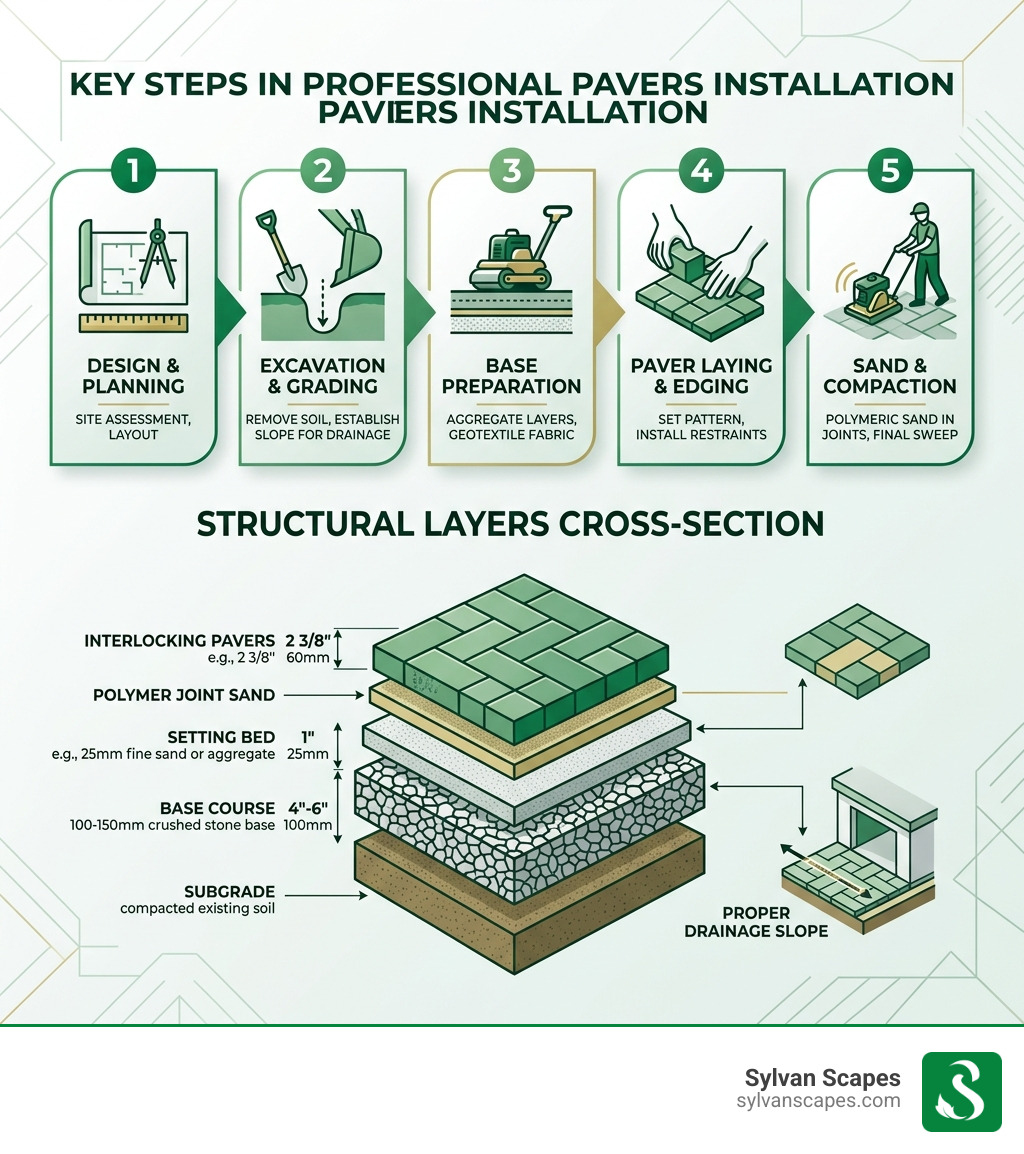
Key steps and structural layers involved in a professional paver patio installation - paver patio contractors infographic

The Advantages of Pavers

When homeowners in Staunton or Charlottesville consider upgrading their backyards, the debate often boils down to pavers versus poured concrete. While concrete is a common choice, interlocking pavers offer a suite of technical and aesthetic advantages that simply can’t be matched by a single slab.

One of the most significant benefits is structural strength. High-quality interlocking pavers are engineered to be up to four times stronger than conventional poured concrete. Because a paver patio is composed of individual units, the surface is flexible. It can “breathe” and move slightly with the natural shifts of the earth, which is vital in our region where soil conditions and moisture levels fluctuate.

Feature Interlocking Pavers Poured Concrete
Strength Approx. 8,000+ PSI Approx. 3,000 – 4,000 PSI
Crack Resistance High (Joints allow for movement) Low (Prone to surface cracking)
Repairability Easy (Replace individual units) Difficult (Requires patching or full demo)
Cure Time Instant (Walk on it immediately) 3-7 days (No traffic allowed)
Maintenance Low (Occasional sweeping/sealing) Moderate (Sealing and crack repair)

Beyond sheer strength, Hardscapes designed with pavers offer superior drainage efficiency. Unlike a solid concrete slab that can collect standing water if not pitched perfectly, the joints between pavers allow for better water management. For those interested in environmental sustainability, we often recommend permeable pavers. These allow rainwater to filter back into the ground, reducing runoff and protecting the local watershed in the Shenandoah Valley.

Perhaps the greatest “peace of mind” benefit is repairability. If a tree root shifts or a heavy object chips the surface, you don’t have to jackhammer the entire patio. A qualified paver patio contractor can simply pop out the damaged stones, fix the base, and reset them. It’s a seamless fix that keeps your investment looking brand new for decades.

Designing Your Space: Materials, Features, and ROI

Designing a patio is about more than just picking a color; it’s about creating a “room” without walls. The material you choose sets the entire tone for your outdoor living experience.

Various paver textures and colors including natural stone and concrete - paver patio contractors

Material Selection

  • Natural Stone: Options like bluestone, flagstone, granite, and travertine offer timeless, organic beauty. No two stones are exactly alike, providing a high-end, custom look.
  • Concrete Pavers: These are the workhorses of the industry. They come in endless shapes, textures, and colors, often mimicking the look of weathered brick or natural slate while offering uniform thickness for easier installation.
  • Clay Brick: Perfect for traditional or colonial-style homes in historic Staunton. They offer rich, permanent color that never fades.
  • Porcelain Pavers: A growing trend for 2024, porcelain is incredibly dense, stain-resistant, and slip-resistant, offering a modern, clean aesthetic.

Enhancing Functionality

A patio is the foundation, but the features make it a destination. We often work with clients to integrate:

  • Outdoor Kitchens: Complete with grills, prep stations, and even pizza ovens.
  • Fire Features: From stone fire pits for roasting marshmallows to elegant outdoor fireplaces.
  • Seating Walls: These provide permanent, overflow seating for guests and help define the “edges” of your outdoor room.

Real Estate Value and ROI

Investing in your backyard isn’t just about personal enjoyment; it’s a savvy financial move. According to the Remodeling Impact Report: Outdoor Features, outdoor upgrades consistently rank high for return on investment. For example, a new wood deck can recover about 80% of its cost at resale, and high-quality hardscaping follows a similar trajectory. Real estate experts note that 9% of realtors recommend adding outdoor features before selling, as they significantly increase curb appeal and help close deals faster.

The Professional Installation Journey

A beautiful patio is like an iceberg—most of the “work” is hidden beneath the surface. If a paver patio contractor shows up and starts laying stones directly on the dirt, stop them immediately. Here is the rigorous process we follow to ensure your patio lasts 30 years rather than three.

1. Site Excavation and Base Preparation

The longevity of your patio depends entirely on the “sub-grade.” We excavate the area to a depth of 8 to 14 inches, depending on the intended load (a walkway needs less than a driveway). We then install a geotextile fabric. This “miracle” layer prevents the native soil from mixing with our clean stone base, which is the primary cause of sinking and “dipping” over time.

2. The Multi-Layered Foundation

We install 4 to 10 inches of Class II baserock aggregate. This isn’t just tossed in; it must be compacted in “lifts” using heavy machinery to ensure there are no air pockets. On top of this goes a one-inch layer of bedding sand, which acts as the “cushion” for the pavers to sit in.

3. Regional Climate Considerations

In the Shenandoah Valley, we deal with “freeze-thaw” cycles. When water in the ground freezes, it expands. If your patio isn’t graded for proper runoff or doesn’t have a solid compacted base, the ice will heave the pavers out of place. Professional paver patio contractors ensure a minimum 1-2% slope away from your home’s foundation to prevent water damage and ice buildup.

4. Finishing Touches

Once the pavers are hand-laid in your chosen pattern (like herringbone or basketweave), we install edge restraints. These are invisible borders that keep the stones from “creeping” outward over time. Finally, we sweep in polymeric sand. This special sand contains a binding agent that, once misted with water, hardens like mortar. It keeps the pavers locked in place, prevents weed growth, and stops ants from making homes in your joints.

How to Vet and Hire Reliable Paver Patio Contractors

Hiring a contractor can feel like a gamble, but you can stack the odds in your favor by looking for specific credentials. You aren’t just looking for someone with a truck and a shovel; you’re looking for an artisan and an engineer.

  • ICPI Certification: This is the “gold standard.” It means the contractor has undergone formal training and passed exams on the technical aspects of interlocking pavements.
  • Liability and Workers’ Comp: Never hire a crew that isn’t fully insured. If a worker is injured on your property or a machine hits your house, you could be liable without this coverage.
  • 3D Design Modeling: Many top-tier paver patio contractors now offer 3D renderings before they ever break ground. This allows you to see exactly how the patio flows with your home’s back door and landscaping.
  • Labor Warranties: At Sylvan Scapes, we believe in our work, which is why we offer robust warranties. Reputable pros typically offer at least a 3-year labor warranty, while manufacturers often provide lifetime warranties on the stones themselves.

Essential Questions for Paver Patio Contractors

Before signing a contract, pull the contractor aside and ask:

  1. “Will you be using subcontractors?” We prefer in-house crews because it ensures consistent quality control.
  2. “How deep do you excavate for the base?” If they say “a few inches,” keep looking.
  3. “How do you handle drainage?” They should have a clear plan for where rainwater will go.
  4. “What is your cleanup procedure?” You don’t want pallets and stone dust left in your yard for weeks.

Red Flags When Interviewing Paver Patio Contractors

  • The “Low-Ball” Estimate: If one quote is 40% lower than the others, they are likely skipping the geotextile fabric or using a thinner base.
  • No Portfolio: If they can’t show you photos of projects they’ve done in Albemarle or Augusta County, they might be “learning” on your lawn.
  • Vague Warranties: “I’ll come back if it breaks” isn’t a warranty. Get it in writing.

Maintaining Your Investment for Long-Term Beauty

One of the reasons pavers are so popular is that they are relatively low-maintenance, but “low” doesn’t mean “no.” A little bit of love goes a long way in preserving that “just installed” look.

Routine Care

The best thing you can do for your patio is to keep it clean. Regularly sweep away leaves, dirt, and debris. If organic matter is left to rot on the surface, it can cause minor staining. A simple garden hose and a mild detergent are usually all you need for a seasonal deep clean.

Joint Stabilization

Every few years, check your joints. If the polymeric sand has washed away in certain spots, it needs to be topped off. This prevents weeds from finding a foothold and keeps the interlock strong.

Professional Sealing

While not strictly required, we highly recommend sealing your pavers every 3 to 5 years. Sealing does three things:

  1. Enhances Color: It gives the stones a “wet look” or a deep matte finish that makes the colors pop.
  2. Resists Stains: It creates a barrier against oil, grease, and wine spills.
  3. Protects the Surface: It helps prevent “dusting” and wear from the elements.

Winter Care in Virginia

When the snow falls in Keswick or Staunton, be careful with your shovel. Use a plastic shovel or a snowblower with a rubber edge to avoid scratching the pavers. Avoid using harsh rock salt (sodium chloride), which can pit the surface of some concrete pavers. Instead, use sand for traction or calcium chloride-based de-icers, which are gentler on the stone.

Frequently Asked Questions about Paver Patio Contractors

How much do paver patio contractors typically charge?

The cost of a paver patio varies based on several factors. On average, you can expect to pay between $15 and $30 per square foot. Factors that influence the price include:

  • Material Choice: Natural stone is more expensive than standard concrete pavers.
  • Site Accessibility: Can we get a skid-steer into the backyard, or do we have to move 20 tons of stone by hand?
  • Demolition: Removing an old concrete slab or a rotting wood deck adds to the labor.
  • Complexity: Curved edges and intricate patterns require more “finesse cutting” and take longer to install.

How long does a typical paver patio installation take?

For a standard 400-square-foot patio, the timeline is usually 3 to 7 days.

  • Day 1: Excavation and hauling.
  • Day 2: Base installation and compaction.
  • Day 3-5: Laying pavers and cutting edges.
  • Day 6-7: Sanding, vibrating the stones into the base, and final cleanup. Weather is the biggest wild card—heavy rain can delay base compaction.

Do paver patios require a lot of maintenance?

No. Compared to a wood deck that needs staining every year or a concrete slab that needs crack injections, pavers are very easy. The use of polymeric sand has revolutionized the industry by virtually eliminating the “weed problem” that used to plague old-fashioned brick patios.

Conclusion

A custom paver patio is an investment in your home’s value and your family’s quality of life. By choosing a qualified paver patio contractor who understands the unique soil and climate of the Shenandoah Valley, you ensure that your outdoor retreat remains beautiful and stable for decades to come.

At Sylvan Scapes, we bring over 20 years of experience to every project. As an ISA Certified Arborist and a company deeply rooted in the Staunton and Charlottesville communities, we don’t just “lay stones”—we build foundations for memories. Whether you envision a sprawling entertainment zone or a quiet garden path, our team is here to guide you from the first 3D design to the final sweep of sand.

Ready to transform your backyard? Connect with a Staunton Hardscape Company that treats your home like its own. Let’s start laying the groundwork for your dream patio today.

What You Need to Know About Careers in Utility Forestry and Environmental Consulting

Careers in utility forestry, environmental consulting, and natural resource management span a wide range of roles – from entry-level field technician positions to senior consulting careers. Here is a quick snapshot of the kinds of opportunities commonly available across this sector:

Category Details
Common openings Utility forestry, environmental field work, GIS support, project management
Frequent entry role Consulting Utility Forester or Field Technician
Typical job types Full-time, temporary, contract, and internship opportunities
Work setting Mostly on-site field work, with limited hybrid or remote positions
Experience levels Entry-level through mid-senior leadership
Hiring trend New postings often appear regularly across multiple states

Utility forestry and environmental consulting remain active employment areas for professionals who want a career connected to land stewardship, vegetation management, compliance, and field operations. Whether you are just starting out or looking to move into a senior role, there can be a meaningful career path here – not just a job.

Many companies in this industry emphasize safety, technical training, and long-term advancement. Roles often combine outdoor field work with data collection, mapping, regulatory awareness, and communication with property owners, municipalities, or utility partners.

I am Kevin Thompson, ISA Certified Arborist and founder of Sylvan Scapes, and my background in tree care and forestry gives me a front-row view of what employers in this sector look for in candidates pursuing careers in utility forestry and environmental services. In this guide, I will walk you through the career paths, qualifications, and benefits so you can make a confident move.

For broader background on the profession itself, the U.S. Bureau of Labor Statistics overview for conservation scientists and foresters is a useful resource.

Understanding Utility Forestry and Environmental Consulting Careers

When you look into careers related to utility forestry and environmental consulting, you are not just looking at tree trimming. Many organizations in this space focus on the technical and planning side of the industry, providing natural resource management, environmental compliance, and vegetation consulting services across the country.

An environmental consultant conducting a detailed wetland study in a natural habitat - davey resource group jobs

The service mix across this field is broad, which is why the job variety is so high. If you enjoy the intersection of technology and nature, there is plenty to explore. Key services often include:

  • Utility Forestry: Helping utility companies manage vegetation near power lines to reduce outages and wildfire risk.
  • Environmental Consulting: Wetland and stream studies, ecosystem restoration, and mitigation support.
  • Water Resource Engineering: Stormwater management and compliance work that helps protect local waterways.
  • Urban Forestry Planning: Using tree inventory systems and GIS-based tools to help cities manage their urban canopy.
  • Invasive Species Management: Identifying and removing non-native plants that threaten local ecosystems.

Whether it is conducting a wetland delineation or managing a large-scale invasive species removal project, these services translate into specific daily tasks for field and consulting teams.

Top Career Paths in Utility Forestry and Environmental Services

If you are browsing current openings in this field, you will notice a few titles appearing often. These roles represent the backbone of the industry and offer distinct paths for growth.

Consulting Utility Forester

This is one of the most common entry points. In this role, you are not usually the one physically cutting the trees. Instead, you serve as the “eyes” for the utility company. You will work independently outdoors, inspecting rights-of-way for vegetation conflicts with overhead conductors. You may use handheld computers for GIS data entry and spend a lot of time talking to landowners to notify them of upcoming work.

Environmental and Field Technicians

For those who love being in the field, Environmental Technician and Utility Asset Management Field Technician roles are common. These jobs often involve:

  • Vegetation management and invasive species control.
  • Pole inspections and make-ready engineering for telecommunications.
  • Traveling to various sites to perform field inventory.

Project and Program Management

As you gain experience, you can move into management. For example, an OSP Fiber Project Manager may oversee the deployment of fiber optic cables, supervise field construction, and coordinate between internal teams and contractors.

Career Path Comparison Table

Feature Entry-Level Technician Senior Project Manager
Primary Work Setting 100% Field / Outdoors Hybrid / Office & Field
Key Tools GIS Handhelds, Measuring Tools Project Software, Budgets
Travel Requirement High (often 100%) Moderate / Regional
Focus Data Collection & Execution Strategy & Client Relations

If you are ready to see where you fit, you can research available roles to find a position that matches your current skill set.

Essential Qualifications for Utility Forestry and Environmental Careers

Because this is a research-driven and safety-sensitive field, employers place a high value on education and certification. You cannot just improvise when you are managing water resources, environmental compliance, or vegetation risk around critical infrastructure.

Education and Background

For many consulting and forestry roles, employers look for a degree or significant coursework in:

  • Arboriculture
  • Forestry
  • Horticulture
  • Environmental Science

Technical Skills

In modern utility forestry and environmental work, a clipboard and a pen are rarely enough. Proficiency in GIS (Geographic Information Systems) software is a major plus. You will also need strong analytical skills to interpret environmental data and provide timely updates to project partners.

The work is often rugged. You need to be physically fit enough to navigate uneven terrain in all weather conditions. A valid driver’s license is usually non-negotiable, as many roles require driving a company vehicle to remote sites.

Safety and Communication

Safety compliance is a top priority across the industry. Beyond safety, you need to be a people person. A big part of many field roles involves landowner notification – explaining to a homeowner why a tree near a power line needs to be pruned.

To get a better sense of specific requirements for active roles, review the fine print on the listings that interest you.

Employee Benefits and the Ownership Culture

One of the most appealing aspects of careers in this industry is the potential for long-term stability, training, and advancement. Some organizations in utility forestry and environmental consulting even operate with employee-ownership structures, while others focus on strong retirement programs and internal career development.

The Perks Package

For eligible employees, benefits in this field often include:

  • Financial Security: 401(k) plans, retirement benefits, and in some cases employee ownership opportunities.
  • Health & Wellness: Health insurance and paid time off (PTO).
  • Field Support: In some roles, a company vehicle, cell phone stipend, or meal per diem may be included when travel is required.
  • Compensation: Overtime pay may apply for hours worked over 40 per week, depending on the role and employer.

Training and Stability

Many employers in this sector invest heavily in training. Internal development programs, safety education, and technical instruction help employees stay current on scientific methods, field procedures, and compliance standards. That focus on growth is one reason these careers can offer real long-term potential rather than short-term work.

Frequently Asked Questions about Careers in This Field

Where are the most common locations for utility forestry and environmental jobs?

These roles are found across the United States, with many opportunities concentrated in regions that have active utility infrastructure, urban forestry programs, transportation projects, and environmental compliance work. Midwest and Southern states often show strong demand, and many positions are field-based with regional travel requirements.

What is the typical salary for jobs like these?

Compensation varies widely by role, employer, and experience level. Entry-level technicians and utility forestry positions often pay hourly wages, while senior engineering or project management roles are more commonly salaried. Overtime, travel compensation, and field per diem may also affect total earnings depending on the employer and assignment.

Are remote or hybrid options common?

The nature of environmental and forestry work is hands-on. Most roles are on-site, field-based, or travel-heavy, while a smaller number of project management, GIS, or administrative positions may offer hybrid flexibility. Fully remote opportunities exist, but they are much less common than field or office-based roles.

Conclusion

Growing a career in the green industry requires a mix of passion for the environment and a commitment to professional excellence. Whether you are exploring utility forestry and environmental consulting careers or considering a local path here in the Shenandoah Valley, the opportunities for growth are immense.

At Sylvan Scapes, we share that same dedication to the science of tree care. We know that whether you’re a utility forester or a residential arborist, the goal is the same: stewardship of our natural world. If you’re looking for Expert grounds maintenance and tree care services in Staunton, Charlottesville, or the surrounding counties, our team of ISA Certified Arborists is here to help your landscape thrive while you grow your career.

The Evolution and Structure of Professional Resource and Consulting Services

To understand how large-scale arboricultural and environmental consulting firms operate, it helps to look at how this segment of the industry developed. Some organizations in this space began as internal research and development teams before expanding into dedicated consulting divisions that handle needs far beyond standard residential tree trimming.

Over time, many of these consulting groups sharpened their focus around three core service areas: environmental consulting, utility vegetation management, and utility asset management. That shift reflects a broader industry trend toward specialization, especially as municipalities, utilities, and land developers face stricter regulatory requirements and greater demand for reliable infrastructure data.

One important feature seen in parts of the tree care industry is employee ownership. In employee-owned companies, staff members also have a stake in business performance, which can encourage a strong culture of safety, accountability, and technical precision. Some of the largest firms in this space employ well over a thousand specialists and generate hundreds of millions in annual revenue, illustrating the enormous scale of modern environmental and utility consulting.

At this larger scale, consulting work is often supported by teams of scientists, arborists, utility specialists, GIS technicians, and field inspectors serving federal, state, and local governments, telecommunications organizations, and land developers. These teams may include professionals with credentials such as ISA Certified Arborist designations, Professional Wetland Scientist certifications, and various engineering licenses. For property owners in our region, understanding the dormant season and what it means for your trees is a great starting point for basic care. For more on that topic, see the USDA Forest Service guide to tree care. For large municipal, environmental, or utility projects, however, these consulting-focused organizations are designed to provide high-level data collection, planning, and regulatory guidance.

Comprehensive Environmental and Utility Services

A utility vegetation management crew performing line clearance operations to protect electrical infrastructure

While we at Sylvan Scapes focus on the health and beauty of individual landscapes in the Shenandoah Valley, large environmental and utility consulting firms operate at a scale that helps keep the lights on and the water flowing for entire regions. Their service offerings are typically divided into specialized categories that blend biology, forestry, and engineering.

Environmental Consulting

This division is where the “green” meets the “legal.” If a developer in Albemarle County needs to know whether a tract contains protected wetlands, or if a municipality needs to restore a local stream, environmental consultants step in to provide the required fieldwork, analysis, and permitting support.

  • Wetlands and Stream Assessments: This involves water resource determinations and securing the necessary regulatory permits from agencies like the EPA or the Army Corps of Engineers. Consultants conduct detailed field delineations, prepare jurisdictional determination requests, and guide clients through the Section 404 permitting process.
  • Stormwater Management and Compliance: Consultants analyze water quality and help implement green infrastructure to manage runoff. This can include designing bioretention facilities, rain gardens, and permeable pavement systems that meet Virginia DEQ standards.
  • Ecosystem Restoration: This is not just planting flowers; it is a scientific process of invasive species management and control, often involving native seed installation and long-term monitoring. Restoration ecologists develop planting plans based on reference ecosystems and track success metrics over multiple growing seasons.
  • Landscape Architecture: Many consulting firms also employ licensed landscape architects who integrate ecological function with aesthetic design, particularly for public parks, greenways, and campus environments.
  • Grant Writing: This is a notable service. Consulting teams may help clients secure funding from private foundations and national competitive grants, which can be vital for cash-strapped local governments.

Utility Asset Management and Line Clearance

This side of the business is more industrial. If you have seen crews inspecting utility poles or trimming branches away from power lines, that is the heart of utility vegetation management.

  • Joint-Use Audits: In telecommunications, multiple companies often share the same pole. Consultants perform audits to manage these shared assets and ensure compliance with National Electrical Safety Code (NESC) standards.
  • Pole Inspections: Some firms use advanced diagnostic tools such as resistance drilling devices to determine whether a wooden pole is rotting internally without removing it from service. These tools measure the density of wood fiber and can detect decay that is invisible from the outside.
  • Infrared Detection: Thermal imaging can be used to find hot spots in electrical equipment before they cause a fire or an outage.
  • Communications Construction: Consulting groups may also manage the physical construction and attachment of fiber optic and broadband infrastructure on utility poles, coordinating between multiple carriers.
  • Outage Prevention: By combining GIS inventory with tree risk assessments, utility contractors and consultants help prioritize which trees need to be trimmed first to reduce the chance of storm-related blackouts.

Technology and Innovation in Urban Forestry

An ISA Certified Arborist using GIS software and a tablet to perform a tree inventory in an urban park

One of the biggest differentiators among modern forestry consultants is how they have moved tree management into the digital age. They do not just look at a tree; they map it, categorize it, and use data to help predict maintenance needs. This is particularly important for municipal planning in areas like Staunton or Charlottesville, where maintaining a healthy urban canopy is a priority.

Many firms now leverage LiDAR (Light Detection and Ranging) and machine learning to create digital tree inventories across entire cities. Instead of relying only on clipboards and visual estimates, they use high-tech sensors to map leaves, branches, trunks, and surrounding conditions across parks and streetscapes.

Traditional vs. Smart Tree Inventories

Feature Traditional Inventory Smart Inventory
Data Collection Manual entry, paper or basic GPS LiDAR, Machine Learning, GIS
Speed Slow, tree-by-tree Rapid, large-scale scanning
Analysis Basic health assessment Ecosystem benefit analysis (CO2, Stormwater)
Management Static list Dynamic software platforms
Risk Prediction Visual inspection only Data-driven risk modeling

Managing Canopy with Urban Forestry Software

A key component of this technology shift is urban forestry management software. These platforms allow city managers to see their entire tree population on a screen.

  • Inventory Management: They track each tree’s species, size, and health status. Each record can include GPS coordinates, photographs, maintenance history, and scheduled work orders.
  • Urban Forest Master Plans: These are long-term roadmaps for how a city should grow and maintain its canopy over the next 20 to 50 years. A master plan typically includes planting goals, species diversity targets, and budget projections.
  • Risk Assessments: Consultants may perform advanced risk assessments and, where needed, use tools such as resistance drilling to better understand structural integrity. Level 1, 2, and 3 assessments follow ISA Best Management Practices and help municipalities prioritize hazard mitigation.
  • Canopy Analysis: Using aerial imagery and remote sensing data, consultants can measure the percentage of canopy cover across a city and identify neighborhoods that are underserved by tree planting programs.
  • Ecosystem Benefits: Modern software can calculate the dollar value of air filtration, carbon storage, and stormwater absorption provided by trees. For example, a single mature oak in Staunton might intercept thousands of gallons of stormwater annually, a value that can be quantified and used to justify urban forestry budgets.

Geographic Presence and Strategic Subsidiaries

While many consulting organizations in this field are headquartered in one state, they often maintain a large footprint through dozens of local offices and project work that reaches across the country. Some of the largest firms operate 25 or more regional offices, enabling them to deploy field crews quickly and maintain familiarity with local regulations and ecosystems.

To bolster their expertise, firms in this sector sometimes acquire or partner with specialized environmental companies. These partners may focus on wetland delineation, stream restoration, archaeological studies, habitat restoration, or invasive plant management. Such acquisitions allow a single organization to cover a remarkably broad range of disciplines under one roof.

By combining these specialties, large consulting groups can offer turn-key solutions. That means a developer or municipality can work with one provider for everything from initial land survey and environmental permitting to final planting and long-term maintenance. For communities in the Shenandoah Valley, this model is especially relevant as local governments increasingly seek comprehensive approaches to managing growth while protecting the region’s natural resources.

Frequently Asked Questions about Large-Scale Environmental and Utility Consulting

What is the relationship between a consulting arm and a parent tree care company?

In some organizations, the consulting division functions as a wholly owned subsidiary of a larger tree care company. While the parent company may focus more heavily on residential and commercial field services, the consulting arm is structured to handle data-heavy, regulatory, municipal, and utility-related work. Many of these consulting divisions trace their origins to internal research and development departments that were eventually spun off into separate business units to better serve specialized markets.

How do consulting firms support municipal grant writing?

With the passage of the Inflation Reduction Act, $1.5 billion was allocated to the U.S. Forest Service for urban forestry. Consulting firms can help cities and non-profits navigate this complex federal funding process by assisting with grant writing, workforce development plans, and the technical data, such as canopy assessments, needed to support an application. This is particularly relevant for Virginia communities that may lack dedicated grant-writing staff but want to take advantage of historic federal investment in urban tree canopy.

What industries do these firms serve?

They are often very diverse. Primary markets commonly include:

  • Utilities: Electric, gas, and water companies.
  • Telecommunications: Fiber optic and broadband providers.
  • Transportation: State DOTs and rail companies.
  • Government: Federal, state, and local municipalities.
  • Land Developers: Commercial and residential builders.
  • Facility Managers: Large campus or corporate grounds.

How does this type of consulting differ from local tree care?

Local tree care companies like Sylvan Scapes focus on the health and maintenance of individual trees and landscapes for homeowners, HOAs, and businesses. Large-scale consulting firms, by contrast, typically work on infrastructure-level projects such as city-wide tree inventories, utility corridor management, and environmental impact assessments. Both types of service are essential, but they operate at very different scales and serve different client needs.

Conclusion

Large-scale environmental and utility consulting shows just how far arboriculture and natural resource management have evolved. From advanced pole inspection tools to LiDAR-based canopy mapping, this side of the industry provides the big-picture data that helps modern infrastructure run smoothly while protecting natural resources.

Here in the Shenandoah Valley, Sylvan Scapes remains focused on the needs of local property owners, HOAs, businesses, and municipalities that want expert care for their own landscapes and trees. Since 2003, our team of ISA Certified Arborists has served Staunton, Charlottesville, and the surrounding region with personalized service built around safety, science-backed recommendations, and long-term landscape health.

Whether you need a health analysis for a prized oak or expert commercial grounds maintenance in Staunton, we are here to help. If you are in Albemarle, Augusta, or Rockingham County, Sylvan Scapes can help keep your corner of the Virginia landscape healthy and vibrant for generations to come.

How Sylvan Scapes’s Premium Lawn Care and Pest Control Beats the Competition

Professional premium lawn care and pest control covers a range of professional services designed to keep your lawn healthy, green, and pest-free year round. Here’s a quick overview of what to expect:

What premium lawn care and pest control typically includes:

Service What It Does
Fertilization & Weed Control Feeds grass and eliminates unwanted plants
Core Aeration & Seeding Reduces compaction and thickens turf
Grub & Armyworm Control Stops insects from destroying grassroots
Mosquito & Fire Ant Control Protects your outdoor living spaces
Termite & Perimeter Pest Control Guards your home’s structure and foundation
Tree & Shrub Care Keeps ornamental plantings healthy and disease-free

Programs typically run on a 4-7 week treatment cycle, with most lawns needing four to six applications per year. The best providers tailor their approach to your specific grass type, soil conditions, and local climate – not a one-size-fits-all schedule.

If you’ve ever watched a weed take over a lawn you spent months improving, you know how discouraging it can be. Some weeds produce up to 100,000 seeds in a single life cycle – meaning one missed treatment can set you back an entire season. Getting the program right from the start matters.

I’m Kevin Thompson, founder of Sylvan Scapes and an ISA Certified Arborist with over two decades of hands-on experience managing turf, trees, and grounds across Virginia’s Shenandoah Valley. Evaluating premium lawn care and pest control programs is something I do regularly for clients who want results they can actually see. In the sections below, I’ll break down exactly what separates a great lawn care program from an average one.

Annual lawn care cycle infographic showing seasonal treatments from pre-emergent in late winter through winterizer in fall

When we talk about premium lawn care and pest control, we aren’t just talking about throwing some fertilizer down and hoping for the best. At Sylvan Scapes, we believe that a truly magnificent lawn requires a partnership between the homeowner and a team of experts who understand the unique biology of Virginia soil. We’ve been serving Staunton, Charlottesville, and the surrounding counties since 2003, and in that time, we’ve learned that the secret to a great lawn is consistency and customization.

Our approach to Staunton Landscaping Company Turf Maintenance is built on a foundation of trust. We don’t believe in trapping our neighbors in restrictive, long-term contracts. Instead, we rely on our results and a 100% satisfaction guarantee to keep you coming back. If a stubborn weed pops up between our scheduled visits, we come back and take care of it. It’s that simple. We treat your property as if it were our own, ensuring that every application of premium lawn care and pest control is timed perfectly for the climate in the Shenandoah Valley.

Technician carefully applying a liquid lawn treatment to a residential front yard - lawn care and pest control

Maximizing Results with Sylvan Scapes’s Premium Lawn Care and Pest Control

To get the best out of your grass, we look beneath the surface. Many lawn services focus only on the green blades you see, but we focus on the soil and the roots. We utilize soil amendments and micronutrients to create a balanced environment where grass can naturally outcompete weeds. By using slow-release fertilizers, we ensure your lawn receives a steady “diet” of nutrients over several weeks, rather than a quick surge that leads to excessive mowing and potential nitrogen burn.

In our region, we deal with a mix of grass types, and each requires a different strategy. Here is a quick look at how we adjust our premium lawn care and pest control based on your specific turf:

Feature Warm-Season Grass (Bermuda, Zoysia) Cool-Season Grass (Fescue, Bluegrass)
Peak Growth Late Spring through Summer Spring and Fall
Fertilization Timing Summer months Spring and Late Fall
Aeration Needs Late Spring/Early Summer Early Fall
Dormancy Turns brown in winter Stays green (if healthy) through winter

The Benefits of Sylvan Scapes’s Integrated Premium Lawn Care and Pest Control

Integration is the key word here. We don’t just kill weeds; we prevent them. Our program utilizes systemic herbicides that travel through the plant to kill it down to the root, ensuring it doesn’t just “grow back” next week. By combining pre-emergent controls (which stop seeds from ever sprouting) with post-emergent solutions (which target existing weeds), we provide a comprehensive shield for your lawn. This integrated approach means fewer chemicals over time because a healthy, thick lawn eventually becomes its own best defense against invaders.

The Science of Seasonal Fertilization and Weed Control

Timing is everything in premium lawn care and pest control. If you apply a pre-emergent too late, the crabgrass has already taken hold. If you fertilize too early in the winter, the nutrients simply wash away into our local watersheds. We follow a strict 4-7 week cycle that mirrors the natural growth patterns of Virginia’s turf. This ensures that the nitrogen balance is always optimal, supporting deep root development rather than just top-growth.

One of the most startling statistics in our industry is that a single weed can produce up to 100,000 seeds. If even 1% of those seeds find a home in your soil, you’re looking at a thousand new problems next season. Our Staunton Commercial Landscaping Company Turf Maintenance programs are designed to break this cycle, creating a barrier that seeds cannot penetrate.

Targeted Weed Eradication Strategies

We are often asked about specific “problem” weeds. Crabgrass is the most common enemy, and we tackle it with split applications of pre-emergent herbicide in the spring to ensure coverage lasts through the heat of July. For those dealing with Bermudagrass (often called wiregrass) invading their Fescue lawn, we offer specialized suppression programs. While Bermudagrass is incredibly hardy, our targeted treatments can achieve an 80-85% control rate in the first year, eventually reclaiming your lawn for the grass you actually want.

Seasonal Nutrient Management

Our year-round programs adapt to the seasons:

  • Late Winter/Early Spring: We focus on pre-emergents and “waking up” the lawn with light nutrients.
  • Late Spring: We push for a “spring green-up” while targeting broadleaf weeds like dandelions and clover.
  • Summer: We focus on stress recovery and protecting the lawn from heat-loving pests.
  • Fall: This is the most critical time for cool-season lawns. We apply “winterizer” treatments that focus on root development and potassium levels to help the grass survive the cold months ahead.

Specialized Turf Services: Aeration, Seeding, and Soil Health

Even the best fertilizer can’t help a lawn that is “choking.” Over time, the heavy clay soils common in Augusta and Rockingham counties become compacted. This compaction prevents oxygen, water, and nutrients from reaching the root zone. That’s where our specialized services come in. You can see the results of these transformations in our Portfolio Entries Turf section.

Core Aeration and Over-seeding

Core aeration is essentially giving your lawn a “breath of fresh air.” We use professional-grade equipment to pull small plugs of soil out of the ground. This reduces thatch buildup and creates pockets for new root expansion. For our Fescue-loving homeowners in Charlottesville and Staunton, fall aeration and seeding is the single most important thing you can do. By broadcasting high-quality seed into these newly created holes, we increase turf density and ensure your lawn stays thick enough to naturally block out weeds.

Soil pH and Irrigation Efficiency

In the Shenandoah Valley, our soil is naturally quite acidic. If your soil pH is off, your grass literally cannot “eat” the fertilizer you’re giving it. We perform soil tests and apply lime to correct this acidity, making the nutrients available to the plant, following best practices established by the Virginia Cooperative Extension.

Furthermore, we help you manage your water usage. Did you know that a properly installed and maintained irrigation system can produce a water savings of over 50% compared to the old “hose-and-sprinkler” method? We offer spring start-ups and winterization to keep your systems running efficiently, ensuring your premium lawn care and pest control investment doesn’t dry up in the summer sun.

Total Property Protection: Mosquito, Termite, and Perimeter Pest Control

A beautiful lawn isn’t much fun if you’re being eaten alive by bugs the moment you step outside. That’s why we’ve expanded our expertise to include comprehensive pest management. Our goal is to create a “safety bubble” around your home. Our Staunton Commercial Landscaping Company Grounds Maintenance services often include these protective measures to keep employees and families safe.

Mosquito and Fire Ant Defense

Mosquitoes are more than just a nuisance; they are a health concern. We apply barrier sprays every 21 days during the peak season, targeting the areas where mosquitoes rest and breed. For fire ants, we offer an incredibly effective solution: a single annual application that provides protection for an entire year. No more painful bites for your kids or pets while they’re playing in the grass.

Sub-Surface and Structural Pest Management

Some of the most dangerous pests are the ones you can’t see.

  • Grubs: These are the larvae of beetles, and they live underground, eating your grassroots. We apply preventative treatments in early summer to stop them before they kill entire sections of your lawn.
  • Armyworms: These pests can march across a lawn and eat every blade of grass in a matter of days. We monitor for them and provide rapid response treatments.
  • Moles and Voles: These critters create tunnels and mounds that ruin the “carpet” look of your turf. We offer mitigation strategies to move them along.
  • Perimeter Pest Control: We apply quarterly treatments to the outer barrier of your home, preventing spiders, ants, and other crawlies from making their way inside.

Frequently Asked Questions about Sylvan Scapes’s Premium Lawn Care and Pest Control

How often should my lawn be treated?

For most lawns in our region, a program of 4 to 6 applications per year is ideal. This usually equates to a visit every 4 to 7 weeks throughout the growing season. This frequency ensures that weed control barriers remain active and that the grass has a steady supply of nutrients.

Is there a guarantee for weed control services?

Yes! We pride ourselves on the quality of our work. If you are on a regular program and see weeds popping up between visits, just give us a call. We will come back out and re-treat those areas at no additional cost to you. Our goal is your 100% satisfaction.

What grass types are covered in these programs?

We have extensive experience with all common Virginia turfgrasses, including Tall Fescue, Kentucky Bluegrass, Bermudagrass, and Zoysia. Because we are led by an ISA Certified Arborist, we understand the specific needs of each species and how they interact with the local soil and climate.

Conclusion

Choosing the right provider for premium lawn care and pest control is about more than just finding the lowest price-it’s about finding a partner who understands the land. At Sylvan Scapes, we bring over 20 years of local expertise, ISA Certified Arborist leadership, and a deep love for the Shenandoah Valley to every property we touch. Whether you are in Staunton, Charlottesville, or anywhere in between, we are here to help you reclaim your weekends and enjoy a lush, pest-free landscape.

Ready to see the Sylvan Scapes difference? Contact us for expert turf maintenance today and let’s get started on making your lawn the envy of the neighborhood.